





Setting up lambs to thrive

For sheep producers, improving lamb survival remains one of the most profitable opportunities within the breeding enterprise. While genetics and seasonal conditions play a role, management decisions made before and during lambing can have a significant impact on the number of lambs marked.
Author: Alison Desmond, BWBL Project Leader
The first 48 hours of a lamb's life are particularly critical. Around 70% of lamb mortality between birth and weaning occurs during this period, making lambing management one of the most important factors influencing enterprise productivity.
Condition score matters
One of the strongest drivers of lamb survival is the condition score of the ewe at lambing. Ewes that reach lambing in appropriate condition are more likely to produce vigorous lambs with adequate birth weights and sufficient colostrum to survive those crucial first days.
Target ewe condition scores (CS) at lambing are:
- Singles: CS3 (avoid exceeding CS4)
- Twins: at least CS3.3+
- Triplets: at least CS3.5+
Monitoring CS at pregnancy scanning and throughout late pregnancy allows producers to identify nutritional shortfalls early. The final 6–8 weeks of pregnancy are a period of rapidly increasing nutritional demand, particularly for twin- and triplet-bearing ewes. During this time, ewes should be managed to maintain condition and avoid weight loss.
Pregnancy scanning provides the foundation for targeted management. By identifying scanned empty, single-, twin- and triplet-bearing ewes, producers can allocate feed resources more effectively and ensure higher-risk ewes receive priority access to quality pasture or supplementary feed.
Why mob size matters
Research consistently demonstrates that smaller mob sizes at lambing improve lamb survival, particularly for multiple-bearing ewes.
The primary reason is the reduced risk of mismothering. When large numbers of lambs are born in the same paddock each day, the risk of ewes and lambs becoming separated increases. Multiple-bearing ewes are especially vulnerable because they must successfully bond with more than one lamb.
Studies have shown that reducing the mob size of twin-bearing ewes by 100 ewes increases lamb survival by approximately 2.25%, equating to a 4.5% increase in lamb marking rates. The impact on single-bearing ewes is smaller but still positive, with survival improving by around 0.85% for every 100-ewes reduction in mob size.
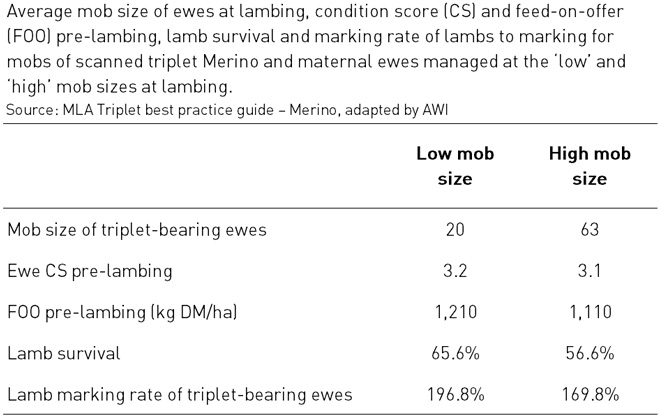
More recent research has highlighted an even greater benefit to reduced mob size in triplet-bearing ewes. The graph below shows reducing triplet mob size by just 10 ewes increased lamb survival by approximately 1.5%, resulting in a 4.5% lift in lamb marking rates.
As a general guide, optimum mob size for twin-bearing ewes is around half that of single-bearing ewes, while triplet-bearing ewe mobs should be smaller again – approximately 30% of the size of twin-bearing mobs.
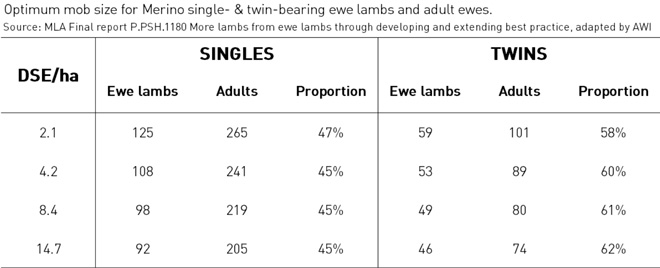
However, there is no one-size-fits-all recommendation, as the ideal mob size will vary between enterprises depending on factors such as breed, stocking rate, fencing and water infrastructure, and lamb value.
Creating smaller lambing mobs
Achieving smaller mob sizes may require producers to rethink paddock allocation and subdivision.
In many cases, the greatest gains come from allocating larger paddocks and mob sizes to single-bearing ewes while prioritising smaller mobs for twin and triplet bearing ewes. Temporary electric fencing can be a practical and cost-effective solution for subdividing lambing paddocks, often delivering a return on investment within a single year through improved lamb survival.
Permanent subdivision can provide additional long-term benefits, including improved pasture utilisation and grazing management. However, many mixed farming enterprises must balance lambing requirements with the operational efficiencies needed for cropping programs.
Regardless of the approach used, pregnancy scanning is essential to maximise the benefits of smaller mob sizes by ensuring the right ewes are allocated to the right paddocks.
The importance of shelter
Providing adequate shelter remains one of the most effective ways to reduce lamb losses, particularly in regions prone to cold, wet and windy conditions.
Newborn lambs are highly susceptible to wind chill, especially during the first few hours after birth. Twin- and triple-born lambs are at greater risk because they are generally smaller and have lower energy reserves than single-born lambs.
Research suggests effective shelter can reduce lamb losses by around 10%. The most effective lambing paddocks contain shelter distributed throughout the paddock rather than concentrated in a single location. Shelter should also provide protection from prevailing winds and encourage ewes to lamb in protected areas.
Importantly, shelter works best when combined with appropriate stocking rates and mob sizes. High ewe densities around shelter areas can increase mismothering and reduce some of the benefits shelter provides.
Choosing the best lambing paddocks
Historical lambing records are a valuable but often underutilised management tool.
Paddocks that consistently achieve high lamb survival rates should be prioritised for higher-risk animals, including twin- and triplet-bearing ewes, maiden ewes and older breeding ewes. Features such as shelter, feed availability, paddock layout, water point location and topography can all influence lamb survival.
Recording scanning and marking percentages by paddock allows producers to identify their best performing lambing environments and replicate those characteristics elsewhere on the farm. This means you need to keep lambing mobs together until you can count them at lamb marking. If you need to box mobs together, it is recommended you it after marking.
Minimising disturbance
The development of a strong ewe-lamb bond is critical to survival. Ideally, ewes should remain undisturbed at the birth site for at least six hours after lambing.
Disturbances from people, dogs, predators, vehicles and unnecessary stock movements can interrupt bonding and increase the risk of separation. Multiple bearing ewes are particularly vulnerable.
Smaller mob sizes help reduce disturbance naturally because fewer ewes are lambing each day, resulting in less interference between newly lambed ewes and other animals in the paddock.
Stacking the gains
There is no single silver bullet for improving lamb survival. The greatest improvements come from combining several proven management practices.
Producers should focus on maintaining ewe condition score targets, scanning and managing ewes according to pregnancy status, providing quality feed during late pregnancy, allocating the best lambing paddocks to higher-risk ewes, ensuring adequate shelter and reducing mob sizes for multiple-bearing ewes.
By stacking these management gains together, producers can lift lamb survival, improve marking percentages and ultimately produce stronger, more resilient lambs that contribute to a more profitable and sustainable sheep enterprise.
More information
This article appeared in the AWI Woolgrower Newsletter June 2026. Reproduction of the article is encouraged and should be attributed as follows: This article was first published in the AWI Woolgrower Newsletter.