




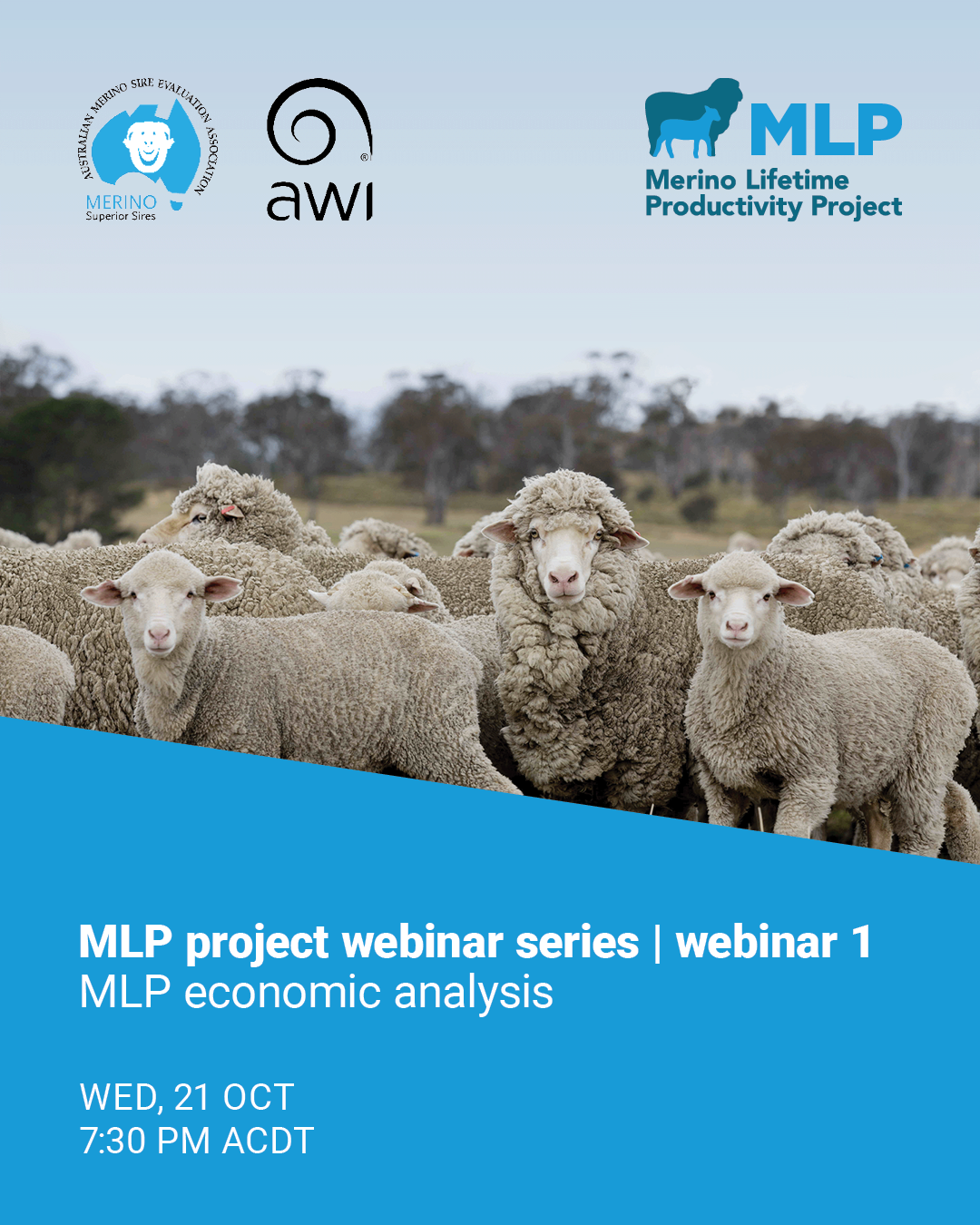
MLP webinar series – Results for ram buyers | Webinar 1: MLP Economic analysis
Hosted by AWI Extension SA
Join us for a three-part webinar series to hear the results from the Merino Lifetime Productivity (MLP) project for ram buyers.
Discover what drives lifetime performance and profitability, and how to apply the insights to your breeding and selection program.
The MLP webinar series will include:
- What did the MLP project research and who are the results impacting?
- How can the MLP insights guide the development of a successful breeding objective?
- How do you select for lifetime productivity? What information helps you make the most accurate selection decisions and gets the best bang for your buck?
- Findings of industry profit drivers from the economic analysis of over 2 million data points.
- A summary of key findings.
- The opportunity to ask questions relevant to your enterprise.
| Webinar 1: MLP Economic analysis | Wednesday, 21 October 2026 |
| Presenters: John Young and Geoff Lindon | |
| Webinar 2: MLP Classing and selection | Wednesday, 4 November 2026 |
| Presenters: Anne Ramsay and Geoff Lindon | |
| Webinar 3: MLP Overall outcomes | Wednesday, 11 November 2026 |
| Presenters: Ben Swain and Geoff Lindon |
NSW, VIC & TAS: 8:00 PM AEDT | SA: 7:30 PM ACDT
QLD: 7:00 PM AEST | WA: 5:00 PM AWST
Register once now and gain access to the three-part series!
What is the Merino Lifetime Productivity project?
After 10 years of research on five diverse research sites, more than 5,700 Merino ewes and over two million validated records, the Merino Lifetime Productivity (MLP) project has created an unprecedented picture of lifetime performance in the Australian Merino, providing stronger evidence to guide breeding, classing and selection decisions.
The project set out to improve lifetime productivity and profitability, strengthen genetic evaluation and benchmarking, improve the timing of assessment decisions, evaluate selection approaches and indexes, assess reproductive performance and its impacts, and support the future competitiveness of the Merino.
Led by Australian Wool Innovation (AWI) in partnership with the Australian Merino Sire Evaluation Association (AMSEA), along with site hosts and industry partners, the 10-year, $13 million project followed more than 5,700 Merino F1 ewes. Across the project, 22,740 joinings were recorded and more than two million validated records collected.
The project generated lifetime information across wool, reproduction, growth and carcase, health and welfare, visual traits, classing and genomics. Almost all ewes were retained regardless of performance, enabling researchers to examine how early assessments related to adult and lifetime performance without the effect of performance culling.
While data collection was completed in August 2024, the work of translating that data into industry outcomes continues.
One of the clearest findings is that there is no single assessment method, age, trait or Merino type that defines lifetime productivity. Instead, MLP reinforces the importance of having a clear breeding objective and combining the information best suited to the traits within that objective.
Many core production traits were shown to be heritable and responsive to selection. Fibre Diameter was very highly heritable from Yearling age, while Body Weight was highly to very highly heritable across life stages. Weaning Rate, however, had very low heritability, demonstrating the strong influence of environment and management and the need for repeated records, pedigree and genomic information to improve selection accuracy.
MLP also confirmed the value of visual classing. Classing was a useful genetic indicator for Clean Fleece Weight, Staple Length and Body Weight, while enabling selection for characteristics such as conformation, feet and legs, and wool quality. However, measurements and breeding values remain essential for traits that are difficult to assess visually and those involved in genetic trade-offs.
The timing of assessment was a major focus. Post-Weaning and Yearling information remain useful for early selection and identifying lower-performing animals, but the project found Hogget and early Adult assessments were generally more heritable and more strongly related to lifetime performance.
For wool traits, Hogget Clean Fleece Weight had a very high relationship with Adult performance, while Post-Weaning Clean Fleece Weight had only a moderate relationship. Hogget fleece assessments also improved the identification of high-profit-per-hectare sires. Both early- and late-maturing sire groups had animals that changed in fleece weight ranking between Yearling and Adult ages, showing why early selection alone can miss animals that perform strongly over their lifetime.
The practical recommendation is a two-stage approach: use young-age information for early decisions and retain Hogget or early Adult assessment where lifetime fleece and reproduction performance is important. Genomics has improved the accuracy and stability of early-life ASBVs, but it has not removed the value of later wool and reproduction records. Current animals should also have their ASBVs updated before annual classing.
Economic analysis showed substantial genetic variation in flock profitability, with fleece value and reproduction emerging as key drivers of profit per hectare. Yet no single breeding philosophy dominated: high-profit sires were found across different Merino types and production systems. The right breeding objective depends on the environment and enterprise and its success in how effectively selection is applied.
More information about the MLP project
- wool.com/MLP
- AWI Beyond the Bale September 2026 edition – The MLP story
- AWI Woolgrower Newsletter September 2026 – MLP delivers a clearer picture of lifetime Merino performance
EVENTS THAT MIGHT INTEREST YOU