


Use the NWD to attract the highest price
All woolgrowers are being urged to complete the National Wool Declaration (NWD), as wool sold as Not Declared usually receives a discount. The NWD provides transparency to buyers and the whole supply chain and helps woolgrowers earn premiums and avoid discounts for their wool.
The National Wool Declaration (NWD) is a simple way for woolgrowers to tell the market more about the wool they produce. By completing an NWD, growers provide information that buyers can’t determine from testing alone – such as mulesing status and other management details – helping the wool move through the supply chain with fewer questions and more certainty.
When AWI engages with brands and retailers, one message comes through consistently: they want to see stronger participation in the NWD. Clear declarations give buyers confidence, support transparency across the supply chain and ensure growers receive clearer market signals about demand and pricing preferences.
Filling out an NWD is voluntary and once lodged, the information automatically flows into sale catalogues and wool test certificates. This means buyers have the details they need at the point of sale, without any extra steps for growers.
All woolgrowers are encouraged to complete an NWD, regardless of breed, wool type or management system. Taking part helps protect market access for Australian wool and ensures growers remain well positioned as customer expectations continue to evolve.
Seasonal Trends in NWD Rates
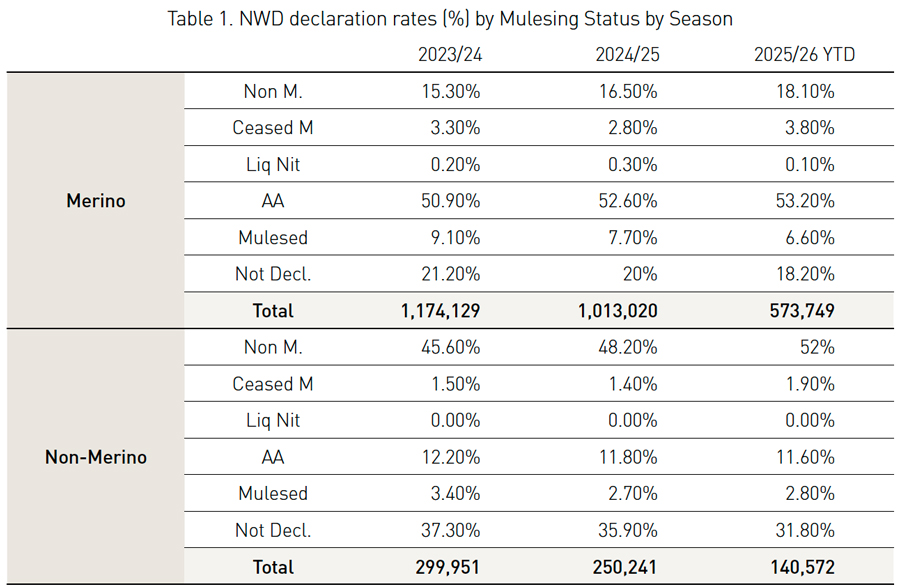
The table highlights a continued shift toward greater use of the National Wool Declaration (NWD), with declaration rates improving across both Merino and Non- Merino wool in the 2025/26 season to date.
For Merino wool, the proportion declared as AA (Non-Mulesed) has steadily increased over the past three seasons, rising from 50.9% in 2023/24 to 53.2% in 2025/26 YTD. Over the same period, the share of mulesed wool has declined from 9.1% to 6.6%, while the Not Declared category has also fallen significantly. The data highlights steady engagement with the NWD across different wool types and production systems, reinforcing its role as an information tool used by growers to communicate with the market.
A similar pattern is evident in the Non-Merino sector, where Non-Mulesed wool now accounts for more than half of all declared bales (52%) in 2025/26 YTD. This is the highest level recorded across the three seasons shown. The decline in the Not Declared category – from 37.3% in 2023/24 to 31.8% – further reinforces improving uptake of the NWD among non-Merino producers.
State Trends in NWD Declaration Rates by Season
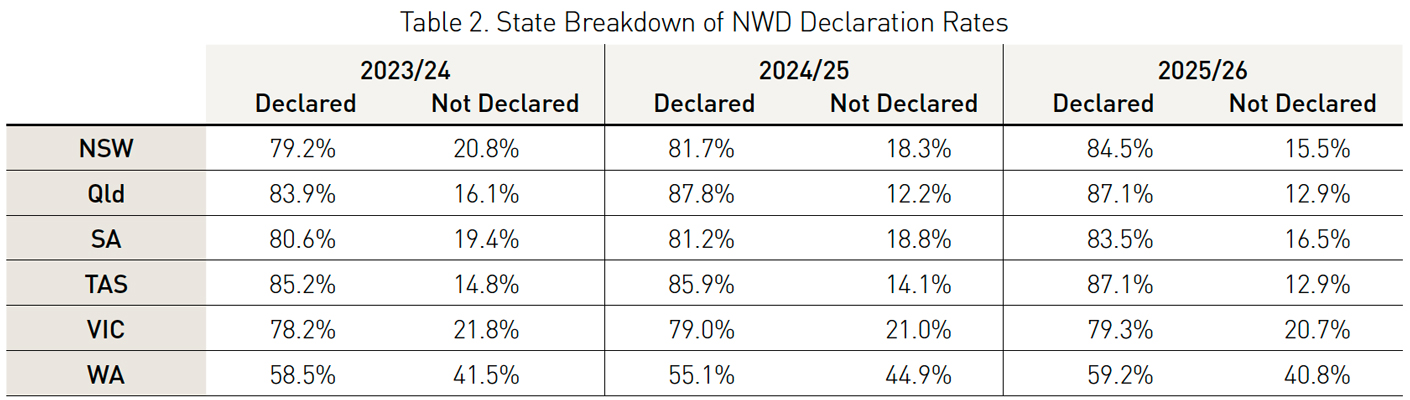
The table shows changes in NWD participation by state over the past three seasons. Overall, most states recorded higher declaration rates in 2025/26 year to date compared with 2023/24, alongside a corresponding reduction in the proportion of wool listed as Not Declared.
New South Wales, South Australia, Tasmania and Victoria each show gradual increases in declared wool across the period. Queensland’s declaration rate remains high relative to earlier seasons, with minor variation between 2024/25 and 2025/26 year to date. Tasmania continues to record one of the highest declared proportions, with more than 87% of wool declared in 2025/26 to date.
Western Australia differs from the national pattern, with declaration rates lower than other states across all three seasons shown. However, WA also recorded an improvement in 2025/26 year to date compared with the previous season, indicating a partial recovery from the decline observed in 2024/25.
Queensland and Tasmania continue to lead declaration and Non-Mulesed rates. Both states benefit from lower flystrike risk – Tasmania due to its cooler climate and Queensland due to shorter fly seasons – making Non-Mulesed production more achievable and sustainable. As a result, these regions consistently set the benchmark for Non-Mulesed wool volumes.
While total bale numbers in 2025/26 are lower year-to-date compared with full previous seasons, the underlying shift toward increased declaration rates and higher participation remains evident.
Micron trends in NWD Declaration Rates for the 2025/26 Season
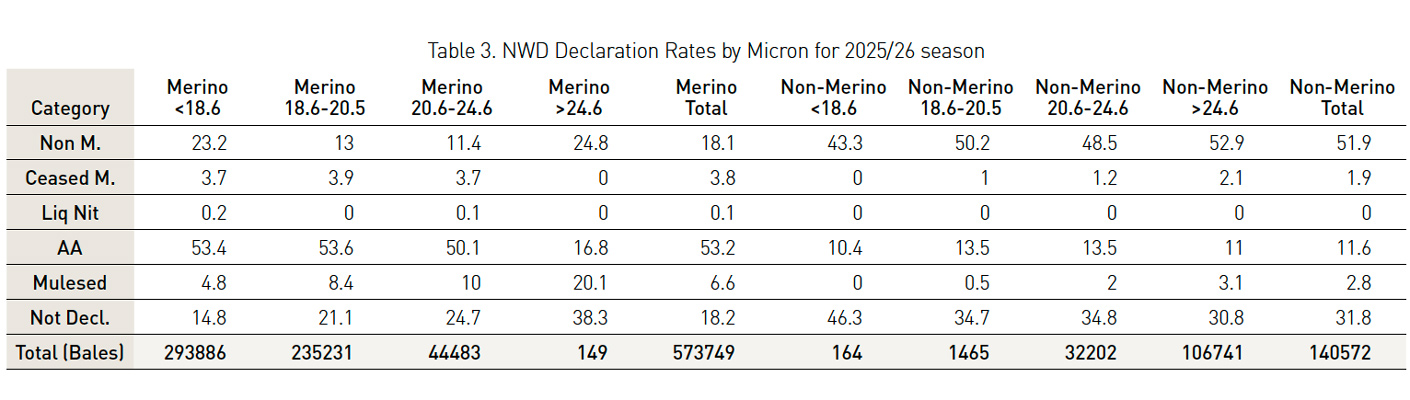
Merino wool in the finer micron ranges is more likely to be declared, with wool under 18.6 microns recording the lowest proportion listed as Not Declared (14.8%). As micron increases, the proportion of Merino wool sold without a declaration also rises, reaching 38.3% in the broadest micron category (>24.6 microns).
Across the Merino clip, the overall declaration rate is 81.8%, while the Non- Merino declaration rate is lower at 68.2%. For Non-Merino wool, the Not Declared category remains highest in the broader micron ranges, although declaration rates improve in the finer microns.
The table shows a clear contrast between finer and broader micron ranges, with Not Declared wool accounting for a smaller share in finer microns and increasing progressively as microns broaden. This pattern is consistent across both Merino and Non-Merino wool, indicating that micron range is closely associated with declaration outcomes.
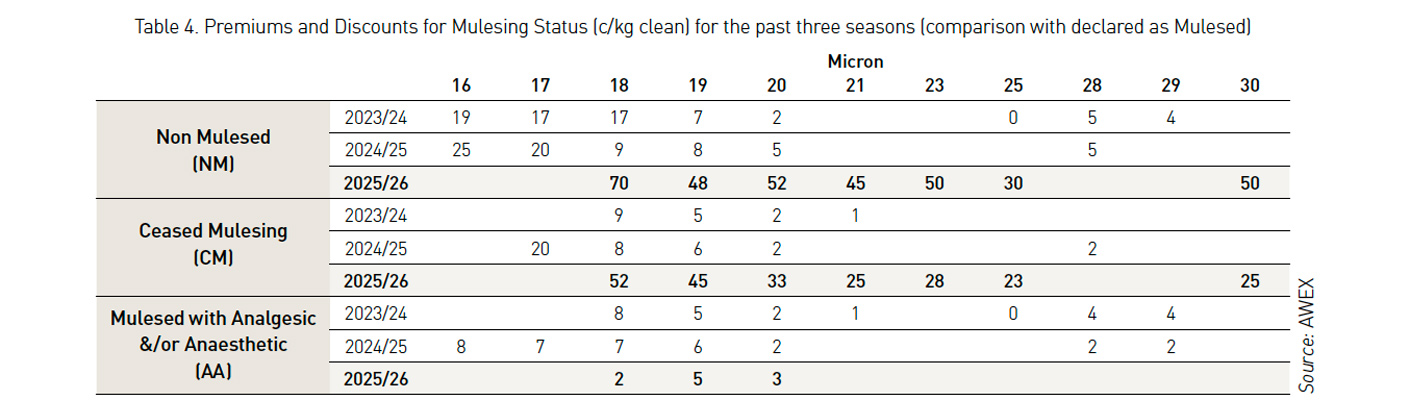
This table outlines the premium and discount outcomes for different NWD declaration categories over the past three seasons, using mulesed wool as the pricing baseline. In the current season, premiums available for both non-mulesed (NM) and ceased mulesed (CM) wool are notably higher than those seen in previous years.
If these premiums continue to be available, they are likely to influence the mix of wool offered under each declaration category over time, which may in turn affect premium levels. Overall, the data reinforces the importance of providing declaration information, as wool sold without an NWD is more commonly subject to discounts compared with declared wool.
Don’t let your Declaration be wasted!
If you don’t sign and date your NWD, the Mulesing Status of your mobs/ lines of wool will not be shown on the sale catalogue and test certificate. This can reduce the number of buyers bidding on your wool, as well as the price you receive.
To ensure the Mulesing Status of your wool is known by potential buyers prior to sale, sign and date the NWD.
It is good practice for owner/managers to talk to the wool classer at the start of shearing to detail all mobs and to sign/date the declaration. Note, eSpecis can be electronically signed.
For further advice on achieving Premiums for your wool, contact your wool broker.
This article appeared in Issue 105 of AWI’s Beyond the Bale magazine that was published in March 2026. Reproduction of the article is encouraged and should be attributed as follows: This article was first published in Issue 105 of AWI’s Beyond the Bale magazine.