




From paddock to proof: why on-farm flystrike research matters
Flystrike has always been more than a line item on a farm budget. For woolgrowers, it is time, labour, stress and constant vigilance – often during the busiest and most demanding parts of the year.
Yet despite decades of management tools, treatments and workarounds, one fundamental question remains unanswered: why do flies strike some sheep – and not others – within the same mob?
That question is now being tackled where it matters most: on commercial farms, with growers at the centre of the science.
At Haylands, just outside Armidale, third-generation woolgrower Michael Edmonds is one of several producers across Australia participating in a national, multiyear flystrike research project supported by Australian Wool Innovation.
Working alongside growers is a research team from Deakin University, including Madison Bone, a PhD researcher focused on flystrike, and Dr Andrew Oxley, a senior lecturer specialising in microbes and how they influence insect behaviour.
Together, they are investigating flystrike from a different angle – not just how to manage it, but why it happens in the first place.
A working wool enterprise, not a laboratory
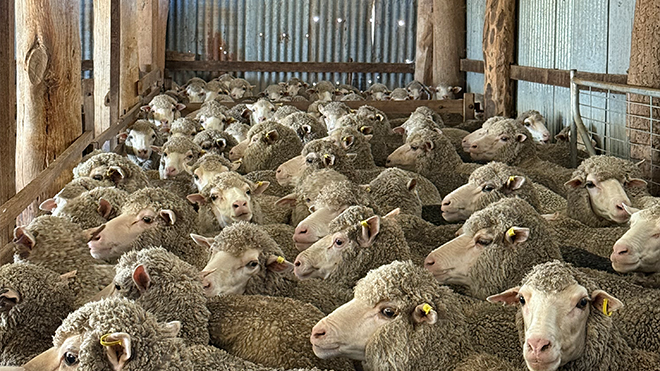
Haylands runs around 1,200 Merino ewes and lambs, alongside 110 prime lambs, producing an average 16-micron clip. Michael farms in partnership with his mother, Elaine, on a property that once carried more than 2,000 Merinos under his father Trevor’s management.
The enterprise is based on native pasture, supported by 25 acres of oats grown on-farm to feed ewes and lambs, with hay and grain provided ahead of lambing. It is a commercial operation shaped by seasons, labour availability and real-world constraints – exactly the environment the researchers said was essential.
“I work off-farm as well,” Michael explained. “So anything we do here has to fit into the routine. You can’t afford things that are too complicated or time-consuming.”
That practicality was one reason he agreed to take part.
Flystrike: the hidden cost
Michael has seen flystrike management change over time – and understands the true cost extends well beyond chemicals or treatments.
“Fifteen years ago, fly was constant. You were chasing sheep every week,” he said. “The real cost wasn’t just money. It was headspace. You were always on edge.”
Breeding plainer-bodied sheep and transitioning away from mulesing around six years ago was a significant decision. While jetting remains part of the program, fly pressure today is far lower than it once was – but never absent.
“You still get some fly strike… You still have to stay on top of it. Anything that can reduce that pressure helps."
“So anything we do here has to fit into the routine. You can’t afford things that are too complicated or time-consuming.”
MICHAEL EDMONDS, HAYLANDS, ARMIDALE
Why this research is different
Traditional flystrike controls – insecticides, husbandry interventions and physical treatments – manage the outcome, not the cause.
“A lot of the strategies we currently use don’t target the root of the problem,” Dr Oxley said. “They’re interim solutions. They don’t explain why flies are targeting certain sheep in the first place.”
“In a paddock full of sheep, some are struck and some aren’t,” Bone added. “And we still don’t fully understand why.”
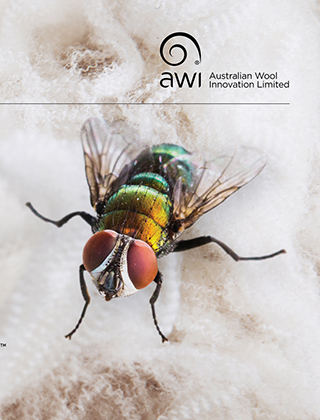
More than 90 per cent of flystrike in Australia is caused by a single species – Lucilia cuprina, the familiar green-bronze blowfly. The unanswered question is why this species targets live sheep, and why certain animals within a mob are repeatedly affected.
To answer that, the team said they needed data that cannot be replicated in controlled laboratory conditions alone.
What on-farm participation actually involves
For growers like Michael, involvement is deliberately straightforward.
“They come out about four times a year,” he said. “We yard up a mob, they sample about 20 sheep, collect flies, and that’s it. Half an hour out of your day.”
Bone said that keeping the workload low was a deliberate decision. “We already know growers are time poor,” she said. “If participation isn’t practical, the research doesn’t work.”
From bacteria to behaviour
Early findings suggest something significant: struck sheep across Australia show surprising similarities, regardless of region, genetics or management system.
“What we’re seeing is that struck sheep tend to be more similar to each other than to healthy sheep,” Dr Oxley explained.
“That suggests there’s a common mechanism at play.”
The team is investigating whether microbes living on the sheep’s skin – and inside the flies themselves – are producing chemical signals that attract blowflies.
“Just like humans, sheep and flies have complex microbial communities,” Bone explained. “Those microbes produce chemicals, and insects are highly responsive to those signals.”
Early work has shown Lucilia cuprina has a distinct bacterial fingerprint compared with other fly species – a clue that may unlock more targeted control strategies.
The long-term goal is not elimination, but diversion: drawing flies away from sheep using attractants that outperform the animal itself.
“If you can reduce fly numbers on-farm by even 50 per cent, that’s a meaningful gain,” Dr Oxley said.
Why it takes time
The project runs over three years – and the researchers said that may still only be the beginning.
Fly seasons are shifting. Climate variability is changing strike patterns. In some recent seasons, strike numbers have been lower than expected, making long-term datasets even more valuable.
“We need data across multiple seasons,” Dr Oxley explained. “Short-term results don’t give growers confidence that something will work year after year.”
Bone agreed: “We want solutions that hold up across climates, regions and management systems – not something narrowly effective.”
Non-chemical options matter
For Michael, one outcome stands out.
“Non-chemical options are really important,” he said. “For the environment. For the sheep. For the future.”
Chemical resistance is already a challenge in fly populations. Behaviour-based attractants – rooted in evolution rather than chemistry – are far less likely to fail over time.
“They’re always going to be attracted to certain chemical cues,” Dr Oxley said. “That doesn’t change.”
Why grower-led research works
For Bone, working directly with woolgrowers reshaped how she approached the science.
“Being out on commercial farms changes how you think,” she said. “You gain an understanding you simply can’t get from textbooks.”
Dr Oxley said that approach reduced the risk of developing tools that failed once they left the lab.
“You can design something that looks perfect in theory,” he said, “but if it doesn’t work in the paddock, it’s useless.”
A message to other growers
Michael was pragmatic about research. He was not looking for promises – just progress.
“I want to see proof,” he said. “If it works, I’ll use it.”
Would he encourage others to get involved?
“Jump in and have a go,” he said. “It’s half an hour out of your day. And if it helps someone else down the track, that’s worth it.”

Why it matters
On-farm research is not an abstract exercise. It is how practical change happens – grounded in paddocks, seasons and people.
For Australian Wool Innovation, projects like this only succeed when growers are active partners, not passive recipients. For woolgrowers, participation helps ensure research dollars deliver tools that respect labour, animals and commercial reality.
And for flystrike – one of the industry’s most persistent challenges – the path forward may not come from the lab alone, but from the collaboration between science and the paddock.
MORE INFORMATION
wool.com/on-farm-research/flystrike-progress/
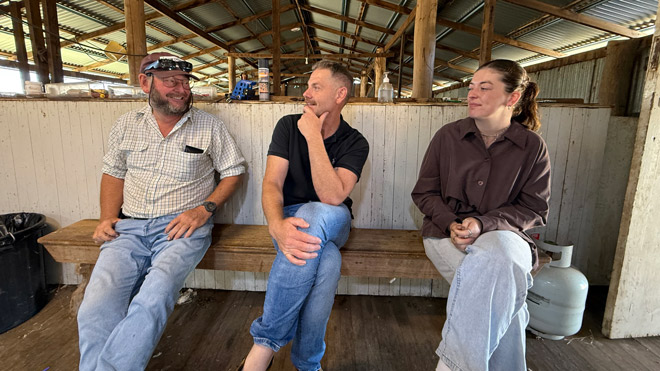
(L–R) Michael Edmonds, Armidale with Andrew Oxley, and Maddison Bone both from Deakin University
This article appeared in Issue 105 of AWI’s Beyond the Bale magazine that was published in March 2026. Reproduction of the article is encouraged and should be attributed as follows: This article was first published in Issue 105 of AWI’s Beyond the Bale magazine.