




Five ways to use drones in sheep operations
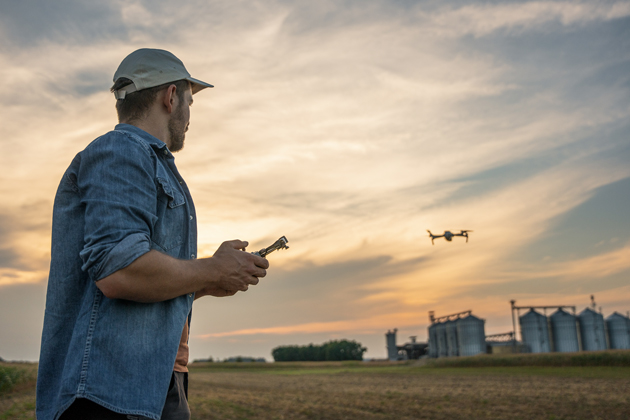
From mustering mobs to checking waters, drones are changing how producers manage their sheep and land. For Queensland woolgrowers David Counsell, Sam Coxon and Andrew Pegler, drones have shifted from a novelty to an everyday management tool in just a few short years.
Adapted from Leading Sheep case study by Emily King, AWI National Extension Manager
Though the following three woolgrower insights are from extensive western Queensland grazing operations, there are some excellent real-life examples of how drones are being used to improve efficiency and effectiveness of sheep and grower welfare and safety, management and infrastructure that will likely be applicable to growers in all regions of Australia.
Meet three woolgrowers using drones in their everyday operations
David Counsell, his wife Genevieve and their adult children, own and operate Dunblane, 10,000 hectares on the outskirts of Barcaldine, Queensland. They run 10,000 head of sheep, 5,000 rangeland goats, and an agistment herd of 1,000 head of cattle when seasonal conditions permit.
Eight years ago, family friends proudly demonstrated their new Christmas toy, a drone they flew over their cotton crops.
“I saw straightaway this was going to be big, and I was busting my gut to get one,” David says. “They are a major tool for us now and fundamental to our business.”
Sam Coxon runs Kateroy, west of Longreach, Queensland, managing 7,500 hectares, 5,000 head of sheep and 300 head of cattle across predominantly Mitchell grass country.
His interest in drones was piqued a decade ago when his son, now an aerospace engineer, built one as part of a university project. Fascinated by the technology but deeming it too complicated for everyday use on their property, Sam put it on the backburner. But as technology became more user-friendly, three years ago Sam purchased a drone to locate stock and vermin and now also uses it for mustering.
With his eye on an upgrade, Sam is now looking for a model with thermal imaging and flight programming, allowing the drone to take off, film the water run and return home – all without Sam lifting a finger.
For Andrew Pegler, who runs Navarra, a broadacre operation near Yaraka, Queensland with 5,000 sheep, 2,000 goats and 300 cattle, the motivation was safety.
With 30,000 hectares to cover with aerial mustering, drones offer a safer, lower-risk alternative to aircraft, reducing both cost and danger while maintaining full oversight of his flock.
Mustering
It’s in mustering that all three growers have seen the greatest impact.
For David, drones have made a big difference to both safety and costs.
“It’s imperative nowadays with the big motorbikes that we’re using, and the high cost of repairs and risks of a WHS incident, that we: 1. reduce the total numbers of kilometres ridden, and 2. reduce the time that we are riding fast,” he explains.
“If you look at the probabilities and impact of an accident, it’s all about how fast you are riding at the time. So, the longer time that you are riding at high speed significantly increases the chance of that accident where you can’t stand up afterwards. The more time you’re riding fast in long grass, the more chances you’ve got of having a prang and getting badly hurt.”
More kilometres on the odometer also means you are closer to that engine rebuild or other major mechanical break down and the associated high costs. That awareness led David to rethink how he musters.
“The drone replaces and reduces the number of miles ridden, and the number of miles ridden quickly, in a massive way,” he says.
“The other day, we had three bikes going and each of us were parked under a tree somewhere behind the sheep while the drones did all the heavy contact work in the long grass. The bikes were just behind the animals if we needed to call on the cavalry, but the drones did a really good job.”
As well as reducing accident risk, David notes that fewer bike hours also means fewer $4,000 motor rebuilds. “Out here, the modern-day bikes just don’t last.”
Sam has also found drones invaluable for mustering, particularly during a period when he’s been unable to ride a motorbike or work in close proximity to livestock due to a health condition.
“I’ve still been able to pen up sheep while Belinda drafts them,” he said.
“Although if I get a bit close, I’ll be hunted away like a bad sheep dog,” he jokes.
Relying on the drone at least three times a week, it’s become an essential tool for Sam to stay productive and connected with the day-to-day running of the property.
Andrew said the impact has been just as significant on his property.
“We use the drone for checking country to find stock and move them to a convenient position. It’s definitely saved costs, time, and made mustering easier and safer.”
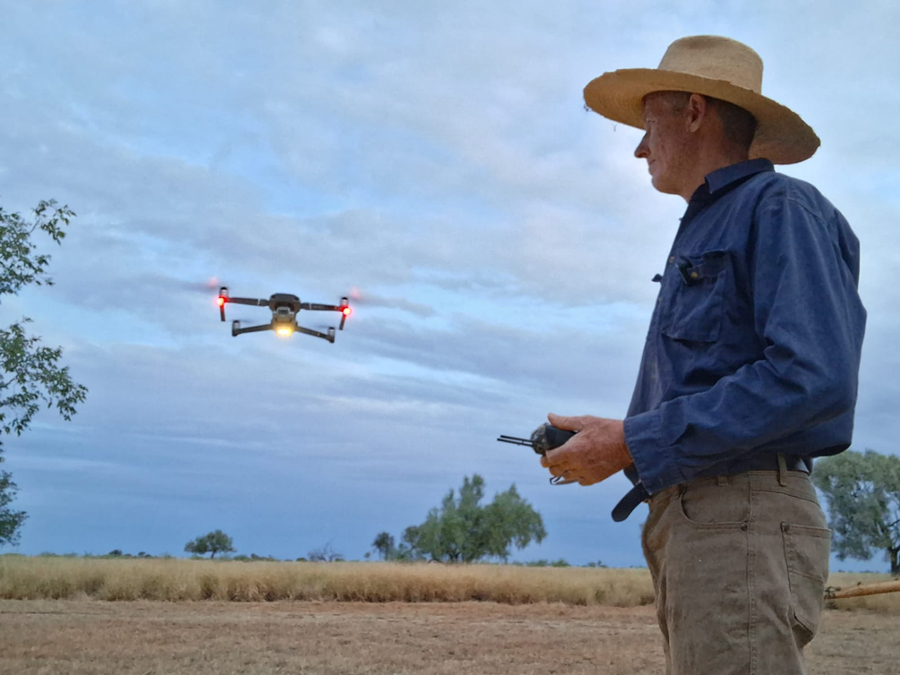
Barcaldine woolgrower, David Counsell, now counts drones as a valuable management tool in his operation.
Infrastructure and land monitoring
No water at the top tank? It must be getting out somewhere.
“You can fly the pipelines in about 20 minutes,” David says.
“You can’t even walk out to the car, get in, and drive to the first gate in that time, and already you know where the leak is.”
David estimates he flies his drone about an hour every second day while on farm, combining inspections with other tasks – but he acknowledges the limitations.
“Looking through the drone lens is a little bit like looking through a pencil. Vision isn’t as good as the human eye. But most of the bigger drones have a telescope lens, so you can see a long way, and there are ways to scan across the landscape.”
There are so many uses for drones. David has also used the drone when sighting in new fence lines.
“We now use the drone in the yards when we are getting sheep out of a water yard and penning up for shearing. Checking waters takes 20 minutes instead of driving around for two hours.
“It’s not as good as a water run in the vehicle but you can fly out 8 km and see water in a trough which brings a lot of peace of mind on a hot day.”
Sam highlighted time, safety, and diesel dollars back in his pocket.
“You don’t have to ride all the way to a corner of a paddock, where there might not even be any sheep. You can check it very rapidly and save somebody bouncing across a Mitchell grass paddock for half an hour which is fraught with danger because of the risk of hitting stumps.”
For Andrew, drones are not generally used for infrastructure checks or monitoring. His focus has remained on mustering and stock management, where the technology provides the greatest benefits for safety and efficiency.
Animal welfare
Drones also play an important role in improving animal welfare.
For Sam, he’s found sheep don’t tend to notice the drone until it dips below 30 metres, allowing him to monitor with ease.
“The ability to check sheep without disturbing them has got to be better for your business, because you’re not going to chase ewes off their lambs when they’ve just had it. A ewe needs to stay with her lamb…after she’s lambed, and if she moves off that spot, she tends to lose the lamb.”
This hands-off approach reduces stress on the animals, allows for quicker identification of injured or sick sheep, and supports intervention if water or feed access becomes an issue.
All three growers agree drones provide a safer, gentler way to oversee stock while maintaining close management of sheep health and welfare.
Predator control
The thermal capability of modern drones offers the potential to spot predators quickly and protect lambing ewes.
“The ability to see animals at night is amazing,” David says. “That’s why I bought my current drone.”
But in practice, he’s found it less straightforward.
“The reality is, by the time you get there, the dog’s gone,” he says.
Instead, a thermal drone’s real value comes in many other ways, like being able to check a paddock remotely late at night if he suspects a gate has been left open or a tank is empty, commencing an early morning muster, walking sheep down a lane at night or to verify that lambing ewes are secure without disturbing them.
Sam has also used his drone for predator management, particularly to track wild dog activity and locate kill sites.
“You can find where they’ve killed quite easily from the air,” he explains. “It helps to get a track of where they are.”
While dogs remain elusive, drones have added another layer of intelligence to Sam’s control strategy, and he sees a drone with thermal capability as a likely next step.
For Andrew, however, predator control simply isn’t practical in his country.
“We have too much stone, and I’m advised that thermal imaging doesn’t work well here because the stone retains heat.”
Managing wet conditions
When floods or heavy rains hit, paddocks can become inaccessible, but stock still need to be moved. Drones let producers see and shift mobs safely, without risking bogged bikes or vehicles.
For David, drones are invaluable when paddocks are boggy and inaccessible.
“You don’t have to waste time looking where the sheep aren’t,” he says.
“The drone lets you see if animals are stuck in corners, bogged, or otherwise hard to reach. How many are there? How do I access that area? It’s one of the top 20 incremental uses of drones for us.”
Both Andrew and Sam have relied on drones to help assess damage after heavy rains.
“During the previous flood, as soon as it was clear, we flew over a couple of paddocks to look for stock and see where fences were damaged,” Sam says.
“It got us out there a lot sooner than we normally would have, so we could at least know what we were looking at to go and do next.”
Grower top tips to get started with a drone or improve their efficacy
Andrew Pegler
- Drones are great, but don’t expect them to do everything.
- Wind can be tricky, so watch the weather.
- Flight time and range aren’t always what the box says – plan for less.
- For mustering, work the stock into the wind or towards water, and pick a time of day when they’re happy to move.
- Mobile phone service (or some form of internet access) where you are operating the drone from is very useful. Without this, basic mapping functions are very limiting.
Sam Coxon
- Use what works for you: if the phone screen’s too small, plug the drone into a tablet instead.
- Don’t go too small – start with a drone that has enough flight time and features to actually get the job done.
- A good camera makes all the difference because even from the air, sheep can be hard to spot in the grass.
- Always charge batteries overnight and keep at least three on hand. Flights last 25–30 minutes, depending on wind and by the time one battery runs low, the next is charged and ready. The drone will automatically return if the battery gets low.
David Counsell
- Just buy one. Spend about $1,200 on a DJI Mini Pro 4, get it out of the box and take it straight up to 30 metres. If you’re nervous, just take your hands off the controls. After all, there’s nothing to hit up there.
- Don’t fly off a dirty phone screen – get yourself a proper controller.
- Get a drone with a speaker. Handy for mustering, talking to someone on a bike, or finding it in the grass if you lose it. You can even play a siren sound to assist with moving stock – the “whomper whomper whomper” sound gets a good response from the animals as it gets closer.
- Insure it when you buy it. Most drone companies offer great insurance. When you prang your drone (and you will), you’re only out of pocket $200 and you will have a new one on your doorstep in no time.
- A drone with thermal capability is expensive but once you are experienced, it’s a must. It makes spotting stock so much easier, especially early in the morning as the sun’s coming up.
This article appeared in the AWI Woolgrower Newsletter July 2026. Reproduction of the article is encouraged and should be attributed as follows: This article was first published in the AWI Woolgrower Newsletter.