




Biosecurity: How does yours shape up?
When the word ‘biosecurity’ is mentioned, it is often met with a mixture of frustration and eye rolls. But before your eyes glaze over, biosecurity is one of the most effective and affordable ways to protect your flock, your productivity and your market access. Prevention is always better than cure, so if you want less threats to your farm, read on…
Author: Jodie Reseigh, AWI Extension SA Project Manager
At the end of the day, biosecurity simply means taking steps to minimise or stop the risk of introducing bad things to your property that you don’t want. These can be diseases, pests, plants and weeds.
Simple biosecurity measures you can undertake include:
- Quarantining livestock
- Forms:
- Transferring your livestock.
1. Quarantining livestock: your first line of defence
Keep incoming sheep separated from existing stock for at least 7–21 days and longer where disease or parasite risks are identified (extend this if high-risk conditions like footrot or Johne's disease are suspected). Ensure you monitor animals for signs of illness, lameness, lice or parasite burdens. Administer appropriate vaccinations, quarantine drenches and check worm egg counts of introduced stock 10–14 days later to clear internal parasites.
It is important to quarantine sheep in an appropriate area, as it provides time to detect and manage risks before they have a chance to spread through your flock.
2. Forms
National Sheep Health Declaration
The National Sheep Health Declaration (NSHD) (formerly known as National Sheep Health Statement or NSHS) assists prospective buyers to make an informed decision about the health status, risks and management history of sheep they are purchasing.
The NSHD is how you can find out about the health status of the animals, including the risk of footrot, lice and Johne’s disease (JD) and any treatments (e.g., drenches, vaccinations) that have been administered to the sheep.
Requirements for NSHD vary between states, sale channels and purchasers. The NSHD is mandatory for all sheep movements in SA and for sheep being moved into NSW and Tasmania. It is voluntary in other states.
Commodity Vendor Declaration
All introduced stock feeds, including hay, grain or silage, should be accompanied by a Commodity Vendor Declaration (CVD). A CVD is your guarantee that the feed you purchased is safe from chemical contamination.
Information contained in the CVD will help you understand any withholding periods or livestock management practices that may affect market access.
Ensure you keep copies of declarations for your records.
3. Transferring your livestock
Livestock leaving your property
Ensure that National Livestock Identification System (NLIS) requirements are met, including National Vendor Declaration (NVD) and National Sheep Health Declaration, as required by your state/territory. Check your current state requirements for sheep electronic identification (eID), as implementation dates and requirements vary across Australia.
Livestock entering your property
If you have purchased livestock from saleyards, a ram sale or on farm auction (e.g. clearing sale), check that livestock movements have been recorded on the NLIS database.
If you are agisting sheep, buying sheep privately (not through a saleyards) or at an online auction, you must record the individual movements on the NLIS database.
For more information, check with your state's Department of Primary Industries or equivalent agency.
Minimise the risk of potential sources of disease
- Restrict unnecessary visitor and vehicle access.
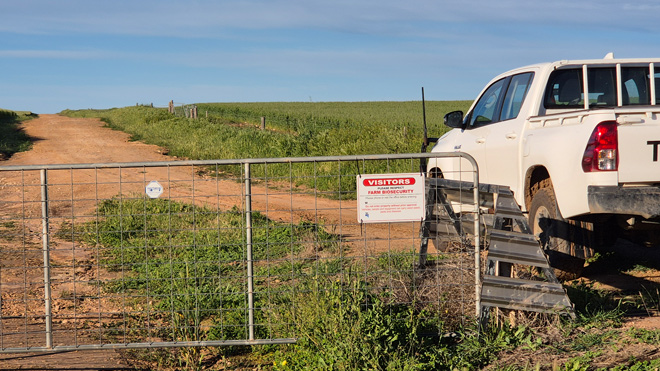
- Use biosecurity signage to remind visitors of property requirements.
- Implement hygiene procedures for incoming equipment and staff (including contractors, agents and brokers).
- Keep records of livestock movements and visitors.
- Maintain fencing to prevent straying stock.
- Monitor flock health regularly and investigate unusual illness or deaths promptly.
- Where practical, limit the introduction of new sheep or buy sheep from people you trust and who can answer your questions before the sale is finalised.
- Emergency reporting – if you notice unusual symptoms or signs of an emergency disease, contact your local Department of Primary Industries or equivalent or the Emergency Animal Disease Hotline on 1800 675 888.
Your biosecurity doesn't need to be complicated. By following a few key principles, you can reduce the risk of introducing diseases, parasites, weeds and resistant worms, protecting your enterprise and the wider sheep industry.
More information
- National Sheep Health Declaration (NSHD)
- Commodity Vendor Declaration (CVD)
- MMFS Tool 11.15 Quarantine periods for important sheep diseases
- MMFS Tool 11.13 Diagnosis, control and eradication of footrot, lice, JD and OB
- MMFS Tool 11.8 Management of worms
- Farm Biosecurity Livestock quarantine: A critical tool for biosecurity and animal health
- National Vendor Declaration (NVD)
- National Livestock Identification System (NLIS)
- MMFS Tool 11.14 Minimising the risk of potential sources of disease
This article appeared in the AWI Woolgrower Newsletter September 2026. Reproduction of the article is encouraged and should be attributed as follows: This article was first published in the AWI Woolgrower Newsletter.