




What scanning is revealing this season
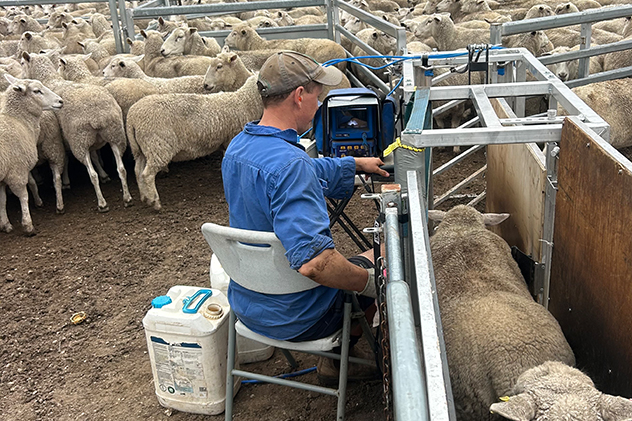
Pregnancy scanning continues to shape flock management across Australian sheep enterprises. Michelle Cousins from Cousins Merino Services shares what she is seeing this season, from multiples recording to the seasonal pressures influencing results.
Pregnancy scanning has become a familiar part of many Merino enterprises, helping producers move beyond simply knowing whether ewes are in lamb to making more informed decisions about feed allocation, mob structure and lamb survival.
While scanning doesn’t change what is already in lamb, it can significantly influence what happens next — particularly when producers scan for litter size and manage singles and multiples differently through late pregnancy and lambing.
Nationally, scanning adoption has been steadily building, although the way producers use scanning information continues to evolve. Some enterprises rely on simple wet/dry scanning to confirm pregnancies, while others increasingly use litter size information to guide feeding programs, paddock allocation and management of twin-bearing ewes.
What is less clear is how scanning behaviour is shifting this season compared with last, particularly in response to seasonal conditions and enterprise pressures across different regions.
To better understand what is happening on the ground this year, we spoke with Michelle Cousins from Cousins Merino Services about scanning trends she is seeing across her client base.
According to Michelle, pregnancy scanning remains an established management tool for many producers.
“Pregnancy scanning of ewes has been seen as an essential tool for management of ewes, with producers well aware of benefits of scanning,” Michelle said.
“Demand has been consistent with our regular clients however we still have bookings from clients scanning for the first time or returning to scanning after not using for a few years.”
Seasonal conditions have also influenced flock structures and mob sizes in some regions.
“Mob sizes have been impacted by drought conditions throughout SA over the last year especially, with some clients having experienced 2–3 years of significantly reduced rainfall. Recent rainfall events have been welcomed,” Michelle said.
Multiples scanning becoming more common
For many producers, scanning for multiples remains the preferred approach when the goal is improving lamb survival and managing nutritional demand through pregnancy.
“Majority of producers are scanning for multiples, looking to manage lamb mortality by meeting nutritional requirements,” Michelle said.
On current numbers this season, Michelle reports 65 per cent of clients are recording multiple pregnancy status, compared with 57 per cent in 2025.
However, there are still several reasons why some producers choose to scan for wet/dry only.
“These reasons for clients choosing to just wet/dry scan are varied and include scanning for sale, don’t have ability to separate mobs for preferential feeding, scanning for first time, and longer joining periods so will doing early/late scans for management mobs,” Michelle said.
Even where multiples are not recorded, scanning results can still provide valuable planning information.
“We often provide a scanning percentage for those just wet/dry scanning giving them potential lambing percentage. Allowing them to use this information to gauge potential lambing numbers and ability to recognise any production issues.”
For many producers, scanning information forms the basis for a range of management decisions through the rest of the season. Identifying dry, single and multiple-bearing ewes allows mobs to be separated and managed according to nutritional demand, with twin-bearing ewes often allocated better pasture or supplementary feeding to support lamb survival.
Scanning results can also influence early marketing decisions, allowing producers to identify dry ewes that may be sold, re-joined or run separately as a wool mob depending on enterprise priorities.
Equally important is the ability to forecast lamb numbers and feed demand months ahead. Knowing how many lambs are expected provides a clearer picture of pasture requirements, supplementary feeding needs and labour planning during lambing.
Across different enterprises the way scanning information is used can vary, but the underlying principle remains the same — providing producers with earlier insight into flock performance and the ability to adjust management accordingly.
Seasonal conditions influencing results
Scanning results this season also highlight how strongly reproductive performance can be influenced by seasonal conditions and ewe nutrition.
“Current scanning rates we are seeing are from between an average of 118% to 138% between regions, with a direct correlation with seasonal conditions and ability to maintain condition score in ewes,” Michelle said.
“Top performers are achieving up to 180%. We have also seen results of 50–60% in areas that have impacted significantly by drought, noting that these are animals that were joined in Oct/Nov 2025.”
Data driving new interest
Michelle says another noticeable shift this season is the growing interest in using scanning results alongside individual animal data.
“Mandatory eid has increased the number of clients looking to record lifetime performance records, using concept of individual animal management to improve reproductive performance,” she said.
Across Australian sheep enterprises, scanning continues to serve a range of purposes depending on seasonal outlook, enterprise structure and management priorities. But whether it is used to confirm pregnancies, identify multiples or inform longer-term reproductive performance tracking, scanning remains a key decision tool in helping producers better manage their flocks.
In a season where conditions and costs vary widely across regions, having clearer information at scanning continues to help producers make earlier and more confident management decisions.
This article appeared in the AWI Woolgrower Newsletter March 2026. Reproduction of the article is encouraged and should be attributed as follows: This article was first published in the AWI Woolgrower Newsletter.