




Set weaners up for a strong start
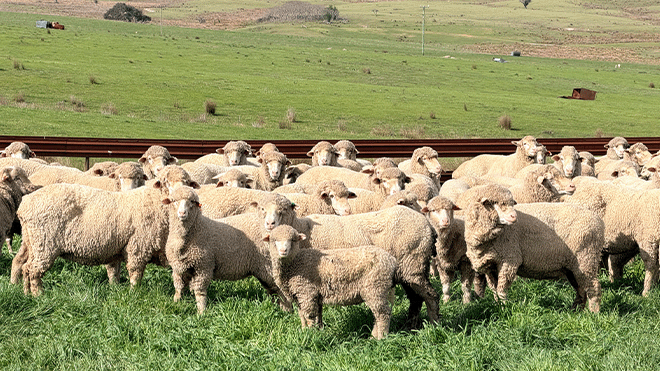
With spring lambs approaching weaning on many properties, planning now can help woolgrowers keep young sheep growing and give ewes time to recover before their next joining.
Weaning is a critical point in the sheep calendar, with management decisions influencing both weaner survival and the lifetime productivity of the flock. AWI’s research encourages growers to use weaning as an opportunity to manage the nutritional needs of lambs and ewes separately.
For lambs, the focus is on reaching suitable liveweights and maintaining growth. For ewes, timely weaning provides an opportunity to regain condition ahead of the next reproductive cycle. The industry benchmark is at least 95% weaner survival from weaning to one year of age.
Plan the timing and know your weights
AWI’s Weaner management checklist identifies no later than 14 weeks from the start of lambing as the recommended weaning time. Having a planned date helps growers prepare paddocks, feed and animal health treatments ahead of the event.
The target weaning weight is 45% of the flock’s standard reference weight (SRW). SRW is the average weight of mature ewes when they are not pregnant, freshly shorn and in condition score 3, with no gut fill. For a flock with an SRW of 60 kg, the target weaning weight is 27 kg.
Weighing all lambs at weaning allows growers to identify the lighter animals and draft them into a separate mob for targeted management. This makes it easier to match feed to their needs and track their progress.
Prepare lambs before separation
If weaners will need supplementary feed at any point in their life, introduce it while they are still with their mothers. Known as imprint feeding, this helps lambs learn to recognise and eat the feed before weaning.
Offer the supplement to ewes and lambs several times over the weeks leading up to weaning. Use the same feed and feeding method planned for the weaners, whether that is trail feeding or self-feeders.
Check that lambs are actually eating the supplement, with a target of at least 90% coming to the feed and eating. Familiarity with the feed can shorten the adjustment period after separation and reduce the risk of shy feeders falling behind in growth.
Feed for continued growth
Young sheep need a diet that supplies enough energy and protein to support growth. A feed budget should account for both the pasture available and any supplements, considering feed quality as well as quantity.
AWI’s Feed budget tables for Merino weaners help growers calculate requirements using actual liveweight, the desired growth rate and the energy and protein content of available feed.
The tables recommend actively managing weaners to grow until 12 months of age, with 50 g/head/day as the minimum growth rate. Maintaining Merino weaners below 30 kg is not recommended.
Keep checking after weaning
Prepare paddocks for pasture production and low worm risk. Review vaccinations and plan an effective weaning drench using WormBoss guidance.
Follow-up weighing is essential. AWI’s checklist recommends tagging 50 weaners as monitors and checking their weights against targets at key stages, starting at 18 weeks.
Alongside weighing, review the feed budget, check water quantity and quality, and carry out worm testing. These checks help growers identify when management needs to change to keep weaners on track.
Practical support from AWI
AWI’s one-day Winning With Weaners workshop helps woolgrowers understand weaner nutrition, survival and growth targets, and develop a management calendar for their flock. Workshops are available through the state-based AWI Extension networks.
A one-hour Winning With Weaners webinar, the Weaner management checklist, Standard reference weight calculator and Feed budget tables for Merino weaners are available on AWI’s weaning webpage.
More information: wool.com/weaning/
This article first appeared in the AWI Extension TAS Newsletter July 2026. Reproduction of the article is encouraged and should be attributed as follows: This article was first published in the AWI Extension TAS Newsletter.