




Powering profitable partnerships — practical tips for working with advisors
Australian woolgrowers want practical, independent advice that helps them cut through the noise. But how can you make sure you are getting the best value from your advisors?
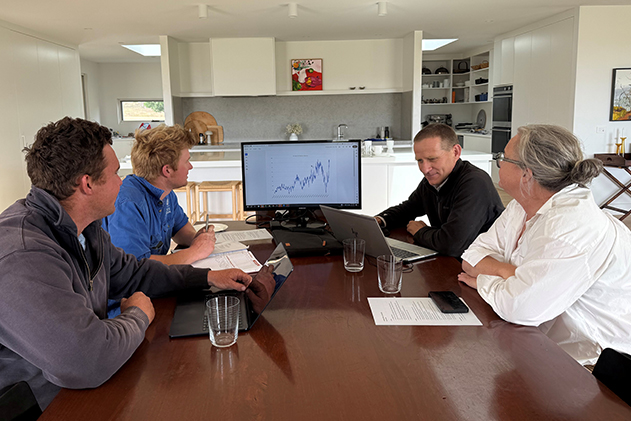
Main image: The Fergusson family of Grindstone Bay Pastoral on the East Coast of Tasmania values the input of proficient consultants to provide advice on sheep classing and farm business. Image with thanks to Sophie Fergusson.
Author: Catriona Nicholls, AWI Extension TAS Project Manager
Running a productive and profitable wool-growing operation involves making complex decisions about breeding and genetics, animal health, welfare and nutrition and business management and much more. Few successful woolgrowers do this alone, and recent research indicates Australian woolgrowers consistently seek out advice from trusted advisors.
An industry-wide survey funded by AWI during early 2025 received responses from more 620 stakeholders. The results indicate when it comes to making decisions about breeding and genetics, woolgrowers most often turn to ram breeders, sheep classers and private consultants for one-on-one advice. And many prefer face-to-face conversations with people they trust rather than wading through complex information on their own.
This reliance on trusted advisors reflects both the importance of breeding decisions in wool-growing operations and the complexity and depth of information available.
Australian woolgrowers want practical, independent advice that helps them cut through the noise. But how can they make sure they are getting the best value from their advisors?
Why use a consultant?
Woolgrowers often engage consultants to gain confidence and peace of mind in their decisions. An outside perspective can highlight opportunities, challenge assumptions, and bring evidence-based knowledge to the table. Consultants are particularly valuable as a sounding board, helping woolgrowers weigh up options and make balanced choices — not just telling them what to do.
Independence is also critical. Respondents to the AWI survey expressed frustration at advice they sensed was influenced by commercial self-interest. They stressed the importance of finding credible advisors who base their recommendations on research and evidence, not underpinned solely by a commercial imperative.
What makes a strong woolgrower–advisor relationship?
The most effective grower–advisor relationships are two-way partnerships. Woolgrowers who come prepared to meetings, share their data and are actively involved in the discussion get far more value for money than those who leave all the work to the advisor.
For advisors, rewarding clients:
- are clear about their goals and priorities
- provide accurate production or financial records before meetings
- ask questions and challenge ideas
- join the advisor in the yards, shed or paddock, rather than leaving decisions to them
- follow through on agreed plans and check progress regularly.
On the other side of the fence, advisors are most effective when they focus on strategic issues, such as breeding objectives, succession planning, or major investment decisions — rather than purely operational tasks.
Costs versus value
Consultants charge in different ways: hourly rates, retainers or per-hectare fees. Rates can range between $80 to more than $400 per hour, with annual fees varying widely depending on the service.
While the cost can feel like a barrier, one well-informed decision, such as avoiding a poor ram purchase or calculating a more profitable stocking rate, can more than cover the consultant’s fees. And the old adage, “you get what you pay for”, rings true when it comes to paying for advice. `
Some banks also view the use of consultants positively, as it demonstrates strategic planning and risk management.
Woolgrowers have no shortage of information, but making sense of it is another matter. Consultants can be a powerful ally in navigating this complex landscape. They bring perspective, independence and expertise that can sharpen decision-making and strengthen farm businesses. But, as with any tool, the value depends on how it is used. Being organised, staying engaged, and treating advisors as partners, can turn consultancy from a cost into an investment that pays off many times over.
Selecting the right consultant
If you are thinking of working with a consultant or advisor, or want to get more out of an existing relationship, here are some practical steps:
- Be prepared: Bring records, questions and clear goals to every meeting.
- Treat it as a partnership: Expect discussion and joint decision-making, rather than one-way instruction.
- Clarify expectations: Set agendas, agree on outcomes, and review progress.
- Stay engaged: Walk the paddock with your advisor, ask questions, and stay involved in decisions.
- Review the value: Assess whether the relationship is improving profitability, confidence, and decision-making.
Grower case study — Grindstone Bay Pastoral, East Coast, Tasmania
External expertise drives action and accountability
Engaging the support of proficient consultants is a key tool in the Fergusson family’s business management toolbox. In addition to capitalising on their technical knowhow, the family utilises regular input from their advisors as a motivational tool to lift their management team out of the ‘day-to-day' grind and drive high-level business strategy.
The Fergusson family runs a multi-generational mixed farming business on the East Coast of Tasmania. They manage 9,000 ha (4,800 ha owned and 4,200 ha leased), running 10,000 head of Merino ewes joined to Merino rams (60%) and terminal sires (40%), and 1,350 ha of cropping.
They also run 4,000 Merino wethers, 700 breeding cows, and operate a cattle trading and finishing enterprise.
During the past 10 years, two of William and Melissa Fergusson’s three sons, Will and George, have returned to the farm after graduating from Marcus Oldham College.
The family has long utilised the services of a professional sheep classing consultant to hone their breeding objective and drive productivity and profitability in their sheep enterprise. According to Melissa, the benefits of having an independent and experienced source of strategic breeding and selection advice is invaluable.
“Our current breeding objective in our stud flock is to hold our micron at 17 µm and increase our fleece weights while maintaining body weights and increasing our lambing percentage,” Melissa explained.
“We have been using eID for 15 years and collect and analyse both visual and objective data every year on our stud ewes and ewe hoggets.
“We crunch the data using KoolCollect livestock management software and our breeding index and generate reports that support our decision making and working alongside our classer just gives us that independent perspective.”
With a mixed farming operation and multiple perspectives within the business, Melissa finds independent expertise invaluable.
“Our classer brings a combination of strong technical expertise and an industry-wide perspective we can draw upon when making decisions around breeding and selection.”
Whole-of-business benefits
In addition to their sheep classing consultant, the Fergusson family also engages the services of a farm business consultant, with whom they meet six times a year.
For eldest son Will, this regular interaction with a whole-of-business advisor is the key to staying on track from a strategic perspective.
“We are all passionate about our areas of responsibility within the business and it is all too easy to get bogged down in the day-to-day operations,” Will admitted.
“It’s time consuming to focus on high-level business development and if you have a complex management team it’s easy to avoid those tasks and just focus on the operational side of the business — putting out bushfires and ‘getting things done’.
“We plan for six meetings a year and we set the next meeting [date] at the close of the current meeting. There is some science suggesting the most action occurs immediately before and immediately after a meeting.
“It’s the regularity that keeps us accountable with the high-level tasks, we might otherwise procrastinate in favour of operational tasks if we didn’t have someone external to the business to hold us accountable.”
As anyone who operates within a multi-generational farming business knows, having an independent perspective can also help take the emotion out of decision making and pave the way for objectivity.
“In additional to his strong business acumen and expertise, our advisor provides a guiding role in a complex family business. He is an important member of our management team, because he understands our business and its complexity and depth, but keeps our decision-making consultative and structured.”
Will noted that in many family businesses relationships can become strained if siblings, or parents, and adult children chip each other.
“By using a regular, formal meeting structure with an external facilitator we have someone who is supportive, can drive progress and hold us accountable.”
Getting the ‘right’ advice
Both Melissa and Will believe it is critical to get the ‘right’ consultant on board. For Melissa this person needs to have a blend of technical proficiency, and a broad industry perspective alongside strong people and communication skills.
“You need someone who is technically sound, has a broad range of experiences with other businesses and enterprises and has well developed listening and communication skills," she said.
“In a multi-generational business like ours, it’s also helpful to engage someone who sits in between the generations in terms of age. Someone who can see the perspectives of both generations.”
For Will, selecting the right consultant also involves understanding the gaps in the business and finding someone who can fill those gaps.
“You need to know what skillset your chasing — to do a ‘needs analysis’,” Will said.
“Mum is an accountant, Dad has a lifetime of production and business management knowledge and skills, and George and I both have Bachelor degrees in farm business management and have worked in other farming businesses before we came home. We all have skills and knowledge, but what we really need is the drive to bring it all together and make it happen.
“That’s what our farm business consultant does for us; he challenges us to look at what we can do better and drives us to become better through improved business and organisational structures and systems.”
“He is still technically proficient and with strong business risk management expertise and he’s great with numbers — he loves a spreadsheet — but it’s his ability to challenge our systems and keep us accountable that offers undeniable value.”
This article appeared in the AWI Woolgrower Newsletter January 2026. Reproduction of the article is encouraged and should be attributed as follows: This article was first published in the AWI Woolgrower Newsletter.