




Australian shorn wool production forecast for 2025/26 revised down to 244.7 Mkg greasy

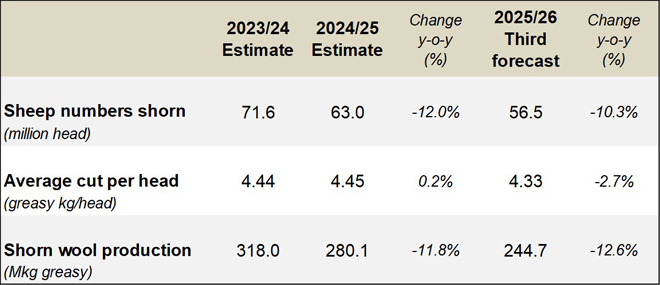
The Australian Wool Production Forecasting Committee’s (AWPFC) third forecast of shorn wool production for the 2025/26 season is 244.7 Mkg greasy. This is 12.6% lower than the 2024/25 estimate and a 6.9 Mkg greasy downward revision of the August 2025 forecast.
- The Australian Wool Production Forecasting Committee’s estimate of shorn wool production for 2025/26 is 244.7 Mkg greasy, 12.6% lower than the 2024/25 season estimate.
- The number of sheep expected to be shorn in 2025/26 is 56.5 million, down 10.3%.
- Average cut per head is expected to be 4.33 kg greasy, down 2.7%.
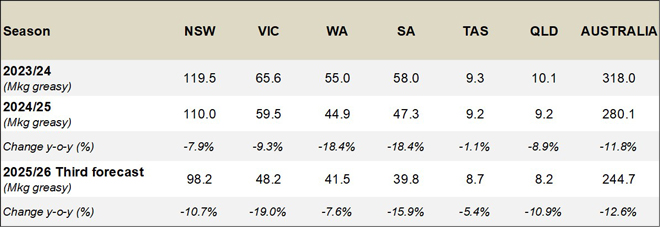
- Shorn wool production is expected to decrease in all states.
Committee Chairman, Stephen Hill said that "Seasonal conditions continue to bite in some key wool producing regions, particularly in southern New South Wales and Victoria. Wool prices are currently 40% higher than last season and sheepmeat prices remain high which has improved producer sentiment regarding wool production. However, sheep numbers remain at historically low levels and are likely to take 18 to 24 months to increase due to low numbers of breeding ewes and continued strong demand for mutton and lamb”.
“The high cost of replacement breeding ewes and concerns regarding stock water availability over summer, particularly in Victoria, are expected to temper any short-term recovery in sheep numbers”.
The October 2025 Sheep Producer Intentions Survey indicated a sharp rise in producer sentiment regarding the wool industry compared with May 2025 with twice as many producers indicating they have a positive rather than a negative outlook.
Sheep and lamb slaughter from July to September 2025 were down 26% and 18% respectively compared with the same time in 2024, but sheep slaughter was still 11% above the five-year July to September average, and lamb slaughter 10% below. Based on ABS slaughter numbers, mutton and lamb production, both sheep and lamb weights were higher than the September quarter in 2024.
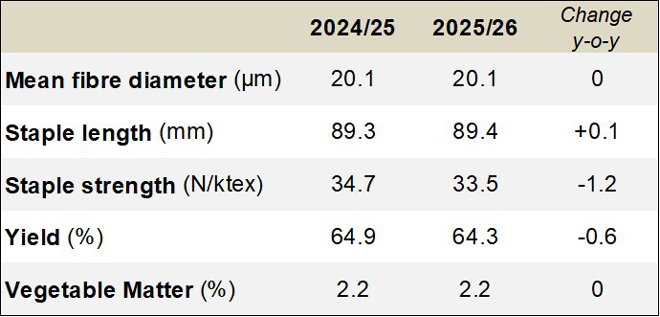
Average cut per head is forecast to be 4.31 kg greasy (down 3.1%). AWTA key test data for the 2025/26 season to the end of November show no change in mean fibre diameter or vegetable matter, a 0.1 mm increase in staple length, 1.2 N/ktex reduction in staple strength and a 0.6% reduction in yield.
AWTA wool test volumes (greasy weight) for the 2025/26 season to the end of November were down by 10.4% on a year-on-year basis. Firsthand wool offered at auction during 2025/26 to the end of November was down by 3.9%.
Table 1: Summary of Australian wool production
Note: Totals may not add due to rounding.
Table 2: Total shorn wool production by state
Note: Totals may not add due to rounding.
Table 3: AWTA key test data for 2024/25 and 2025/26 (July to November)
The National Committee drew on advice from the six State Committees, each of which includes growers, brokers, private treaty merchants, sheep pregnancy scanners, representatives from State Departments of Agriculture and the Australian Wool Testing Authority. Data and input were also drawn from AWEX, wool exporters, the Australian Bureau of Statistics, ABARES and Meat and Livestock Australia.
The state and national Committees will next meet in mid-April 2026.
The full forecast report will be available on the AWI website at www.wool.com/forecasts from 23 December 2025.
Released by:
Kevin Wilde
Australian Wool Innovation, General Manager, Consultation and Engagement
Mobile: +61 436 031 277