
Feed budgeting pays
Rather than stepping away from the industry, Tasmanian woolgrowers Will and Nina Bennett made a deliberate decision to reinforce the role of wool in their family business and change how they manage it.
Author: Megan Rogers, AWI Extension NSW Project Manager
Feed budgeting is an essential tool to ensure adequate nutrition for sheep, minimising feed wastage and optimising productivity. Feed budgeting allows for better and more timely decisions regarding stocking rates, supplementation needs and selling strategies, and helps plan for feed deficits and surpluses. Basically, it’s the cornerstone of grazing management.
What is feed budgeting?
Feed budgeting is the process of matching animal demand with feed supply. It is an essential tool that involves:
- planning for feed deficits and surpluses
- ensuring adequate nutrition for all classes of stock
- recognising that different classes of sheep have different requirements
- prioritising pasture as the cheapest form of feed
- using supplementary feed strategically where required.
Feed budgeting supports timely and informed decisions about:
- stocking rates
- supplementation
- selling or agisting stock.
Feed budgeting underpins livestock health, welfare outcomes and whole-farm profitability.
Why feed budget?
Feed budgeting helps:
- understand key periods of feed demand and supply.
- match feed supply and demand in both good and poor seasons.
- plan paddock use, feed purchasing, storage and selling strategies.
Targeted feed budgeting enables differential management of stock, particularly pregnant ewes, by considering:
- pregnancy status
- feed on offer (FOO)
- shelter and water access.
By aligning feed supply with animal needs, producers can improve:
- conception
- ewe and lamb survival
- lactation performance
- lamb growth
- wool growth
- ewe recovery for the next joining.
Similarly, feed budgeting for young, growing stock enables the appropriate levels of supplementation and reaching desired growth rates. It also allows specific nutrition to ensure growth targets are met.
Cost control and profitability are improved by avoiding unnecessary feed purchases and ensuring feed is directed to stock where it delivers the greatest return.
Adequate nutrition also supports animal welfare by reducing stress and disease risk during high-demand periods such as pregnancy, lambing and lactation.
Feed budgeting essentials
Accurate feed budgeting relies on five core feed components:
- Dry matter
- Digestibility
- Energy
- Protein
- Fibre.
Each component plays a role in determining how much nutritive value sheep can obtain from a feed. Following that, you need to understand the source of the feed and the quantity of it that you have available.
Dry matter (DM)
Dry matter is everything remaining in the feed after all the water has been removed. The calculation for determining the amount of dry matter in your feed is: dried total sample weight ÷ total sample weight × 100 = DM%. You will find this figure on feed tests.
Key principles:
- Water has no nutritive value and must be removed from calculations
- DM is expressed as a percentage of the original sample
- Dry matter is expressed differently for paddock and supplementary feed:
o Paddock feed is kilograms of dry matter per hectare (kg DM/ha).
o Supplementary feed is DM%. - DM is the basis for all comparisons between feeds.
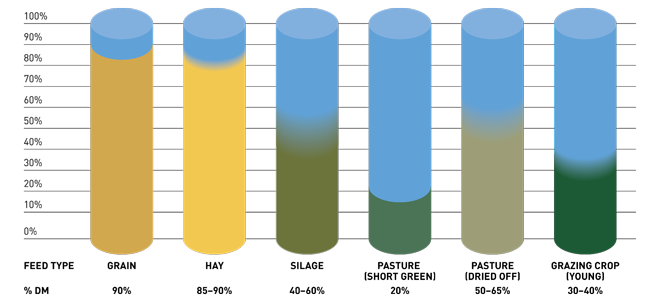
Typical dry matter percentages in common feeds:
- Grain: ~90%
- Hay: 85–90%
- Silage: 40–60%
- Short green pasture: ~20%
Source: Australian Wool Innovation
Digestibility (DOMD)
Digestibility describes how much of the feed eaten can be utilised by the animal. It represents:
- The proportion of feed retained for weight gain, milk production, wool growth or fetal development.
- The amount of energy able to be obtained per kilogram of dry matter.
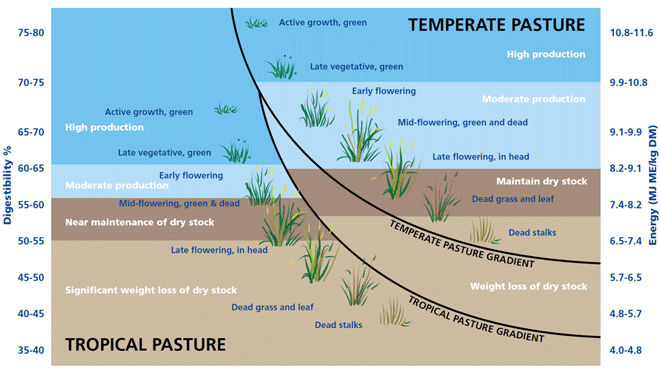
Digestibility is expressed as a percentage of dry matter (DM). As plants mature, digestibility declines due to thicker cell walls, higher stem-to-leaf ratios and the movement of sugars into seed. The image below illustrates the decreasing digestibility of pastures as they complete their life cycle.
Source: South East Local Land Services
For sheep, the most accurate measure of digestibility is the dry organic matter digestibility (DOMD%) figure from the feed test.
Energy (ME)
Metabolisable energy (ME) is the amount of energy available to the animal for:
- Maintenance
- Production
- Reproduction.
ME is expressed as megajoules per kilogram of dry matter (MJ ME/kg DM) and is calculated from digestibility. Higher digestibility results in higher ME.
Protein (CP)
Crude protein (CP) is expressed as a percentage of the feed sample. Feed laboratory values are expressed on a dry matter (DM) basis.
Important considerations:
- CP includes true protein and non-protein nitrogen. Both forms can be used by ruminants.
- The testing method for calculating protein differs depending on whether it is measured at a feed testing lab or at a test stand at a silo, so these numbers will be different.
- It is recommended that growers get a feed test to understand the true feed value for animals.
Fibre (NDF)
Fibre is the structural component of plants and includes cellulose, hemicellulose and lignin.
It is expressed as either Neutral Detergent Fibre (NDF) or Acid Detergent Fibre (ADF). For sheep, NDF is most relevant. Fibre content governs daily intake, with higher fibre feeds limiting how much sheep can consume.
The industry rule of thumb for a sheep’s maximum intake as a percentage of their liveweight = 120 ÷ NDF% (found on the feed test).
Examples applying this rule of thumb follow:
- Oats with an NDF of 33.4%: 120 ÷ 33.4 = 3.5% of liveweight
- Medium quality hay with an NDF of 55.7%: 120 ÷ 55.7 = 2.15% of liveweight
- Low-quality cereal stubble with an NDF of 70%: 120 ÷ 70 = 1.71% of liveweight
If your ewe is 50 kg, the maximum she can consume per day using the examples above would be:
- Oats: 3.5% x 50 kg = 1.75 kg
- Medium quality hay: 2.15% x 50 kg = 1.08 kg
- Low-quality cereal stubble: 1.71% x 50 kg = 0.86 kg
Feed quality matters
Feed quality has a direct impact on:
- Daily energy intake
- Feed required per head
- Total feed costs.
Feed tests provide certainty about:
- Dry matter
- Energy content
- Protein levels.
This certainty supports predictable animal performance and confident feed budgeting decisions.
Feed testing
Feed tests are:
- Affordable
- Accurate
- Essential for predicting animal performance.
Feed tests allow growers to:
- Understand the true nutritive value of feed
- Calculate costs per unit of energy and protein
- Account for water content in feed.
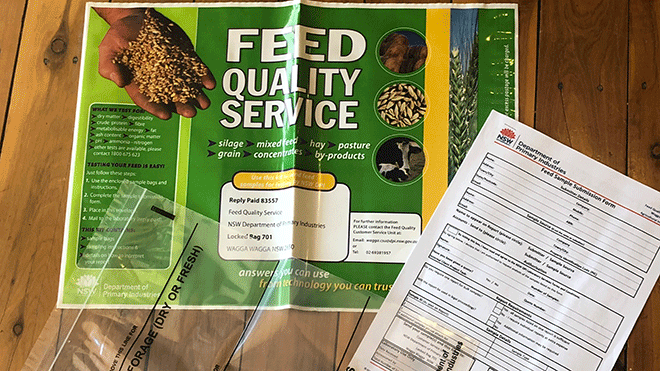
Proper sampling and following laboratory instructions are critical for reliable results.
Feed tests remove guesswork and help avoid both underfeeding and overfeeding.
Source: Australian Wool Innovation
Sheep nutritional requirements
Effective feed budgeting depends on knowing sheep energy and protein requirements at different stages of the production cycle.
High-requirement stock include:
- Pregnant and lactating ewes
- Growing lambs.
Dry sheep have lower requirements than pregnant or lactating ewes.
Standard reference weight (SRW)
Standard reference weight (SRW) is the liveweight of a fully grown, bare shorn, non-pregnant sheep in condition score 3 with no gut fill.
Key points:
- SRW does not change unless sheep type or breed changes
- SRW underpins accurate feed budgeting and dry sheep equivalent (DSE) calculations
- Knowing SRW avoids overfeeding and underfeeding.
SRW is estimated by weighing and condition scoring a representative sample of dry ewes and adjusting for gut fill, condition score and fleece weight.
LOOK UP AWI Standard reference weight calculator
Feed budgeting in practice
Feed budgeting involves answering five key questions:
1. What do your sheep need?
2. What are they getting from the paddock?
3. Is this above or below requirement?
4. What is the ME of the supplement?
5. How much do you need to feed?
The AWI and LifetimeWool Feed budget tables provide a simple five-step process to work out if your sheep are getting their requirements, and how much to feed if there is a deficit.
Once the per head calculations are made, simply multiplying by the number of head per mob will give the daily requirements. Forward planning involves looking at scenarios based around the reproductive status, or age of young stock. Use the AWI feed budget tables to further predict future requirements.
Flock feed budgets allow the producer to predict requirements over a determined period, and thereby facilitate forward planning of acquisition, and storage of supplementary feed requirements.
There are multiple benefits from regular, accurate flock feed budgeting, and it need not be a complex task when following the above steps in the process.
More information
- AWI Feed budget tables for Merino Weaners
- LifetimeWool Feed budget tables for drought/dry conditions in southern Australia
- LifetimeWool Feed budget tables for green pastures in south eastern Australia
- LifetimeWool Feed budget tables for the break of the season in annual pasture systems of southern Australia
- AWI Lifetime Ewe Management (LTEM) app
- AWI Drought Resources
- AWI, MLA and CSIRO Grazing modern stubbles booklet
- AWI, MLA and CSIRO Stubble grazing calculator
- AWI Feed Budgeting Masterclass
- AWI Winning With Weaners
- AWI and RIST Lifetime Ewe Management
This article appeared in the AWI Woolgrower Newsletter November 2026. Reproduction of the article is encouraged and should be attributed as follows: This article was first published in the AWI Woolgrower Newsletter.