




From drought to renewed confidence
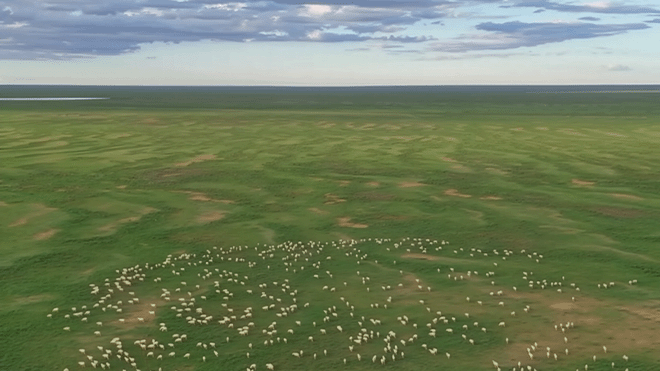
Improved seasons, stronger markets and constrained wool supplies are restoring confidence, although rebuilding Australia’s flock and national clip will take time.
After two exceptionally difficult seasons, improved rainfall and stronger wool and livestock prices have transformed the outlook for many woolgrowers. AWI Chairman and Collinsville principal George Millington believes constrained supply and continuing demand provide grounds for optimism over the next 12 to 24 months.
For woolgrowers across large parts of southern Australia, the difference a year can make is difficult to overstate.
Australian Wool Innovation Chairman and Collinsville principal George Millington said many traditional sheep and wheat regions had endured two of their hardest seasons before conditions turned around during the past 12 months.
“In South Australia, and a lot of the southern traditional sheep-wheat zone extending from Western Australia, through South Australia and into Victoria, we probably had, prior to the last 12 months, two of the hardest seasons ever,” George said.
On the Collinsville properties in South Australia’s Mid North, two consecutive years of record-low rainfall placed sustained pressure on livestock, pastures and farm businesses.
“We had record-low rainfall two years in a row,” he said.
“That meant a lot of handfeeding and a lot of different ways of trying to find the most productive way of running a self-replacing Merino enterprise under very trying conditions.”
The experience reinforced that even carefully developed business plans remained vulnerable when seasonal conditions did not cooperate.
“You can have the best business plan, the best team, the best idea and the best way you think you can run your business going forward,” George said.
“But if you don’t get the rain at the right time, it turns all that upside down, and that was the case for the previous two years.”
A remarkable turnaround
The past 12 months have delivered a vastly different picture. George said areas north of Adelaide and extending into South Australia’s northern pastoral regions were experiencing one of their strongest seasons in many years.
“The last 12 months have been such a massive turnaround. It is hard to believe,” he said.
“We’re probably having the best season north of Adelaide and into the northern pastoral zones of South Australia that has been seen for the last 15 years.”
Some areas of the Flinders Ranges have recorded exceptional winter and spring rainfall, providing welcome relief following the extended dry period.
The improved season has coincided with very strong returns for lamb and mutton, as well as a substantial recovery across sections of the wool market.
George said some micron categories had increased by about 60 per cent, while the Eastern Market Indicator had risen from around 1200–1300 cents 18 months earlier to approach 1900 cents.
The combination had brought renewed confidence to businesses that remained committed to wool production through difficult seasonal and market conditions.
“It’s heartwarming to see people who have stuck with their model and stuck with staying in Merinos, being a dual-purpose animal, now being rightly rewarded,” he said.
“The future is actually looking quite bright.”
Reduced supply shapes the outlook
George said the significant reduction in Australia’s wool clip was an important part of the market outlook.
The national clip had declined from about 350 million kilograms to approximately 250 million kilograms as growers reassessed their enterprise mix.
“People running wool-growing enterprises have choices,” he said.
“They can crop, run prime lambs, cattle, cotton and all sorts of things. People are going to change their business enterprise mix to try to provide the best value for money out of their enterprise.”
George said four years of unsustainable wool prices had prompted some producers to move away from wool. During a recent visit to China, he delivered that message directly to early-stage processors on behalf of Australian woolgrowers.
He said processors increasingly accepted Australia’s reduced production forecasts and understood that more sustainable prices would be required to support future supply.
“I was actually surprised at very little pushback in terms of price,” he said.
“They now realise, and they now believe our forecasts and what we are actually going to produce. They can see that they have to pay a more sustainable price going forward.”
With wool grown from an animal that must first be bred and raised, supply cannot respond quickly to improving prices. George said that constraint, coupled with a reasonably buoyant demand outlook, provided positive signals for woolgrowers.
A similar supply-and-demand story was emerging in the sheepmeat sector, with historically low ewe numbers in Australia and continuing international demand for lamb and mutton.
While rainfall would remain the greatest unknown, George said the current combination of improved seasonal conditions and stronger prices was likely to encourage more growers to retain their Merino enterprises.
Recent industry feedback, producer intention surveys and conversations with growers across the eastern states and Western Australia were already indicating renewed confidence. However, rebuilding production would take time.
Against a backdrop of limited wool and livestock supply, the outlook for growers who had maintained their breeding flocks appeared considerably stronger than it had just 12 months earlier.
“It’s looking fairly rosy and it’s a good, profitable industry to be in over the coming 12 to 24 months,” George said.
Forecast points to a stabilising national clip
The latest national forecast supports George’s view that confidence is beginning to return, although Australia’s wool production is expected to ease slightly again in 2026/27.
Australian shorn wool production is forecast to reach 249.3 million kilograms greasy, down 1.8 per cent from the estimated 253.9 million kilograms produced last season.
The main factor is fewer sheep. Around 56.3 million sheep are expected to be shorn, 4.7 per cent fewer than in 2025/26 and still historically low following several difficult seasons and high turn-off.
However, improved seasonal conditions are providing some encouraging signs. Rain across South Australia, Victoria and much of Western Australia has lifted feed availability and sheep condition. Better wool cuts are expected to partly offset the lower number of sheep shorn, while strong scanning, lambing and marking results have been reported in several regions.
The May 2026 Sheep Producer Intentions Survey also found more producers were looking to retain stock, rebuild their flocks and increase breeding ewe numbers. With replacement ewes commanding high prices, much of that rebuilding is expected to occur gradually through natural increase.
The turnaround has been particularly strong in South Australia, where Merino marking rates of between 80 and 130 per cent have been reported and wool cuts have improved by 10 to 20 per cent in some districts. Wool production in South Australia is forecast to rise by 4.3 per cent, while Western Australian production is expected to increase by 4.4 per cent.
Conditions remain more varied across eastern Australia. New South Wales continues to be the country’s largest wool-producing state, but conditions range from favourable in some districts to dry in the Monaro and parts of northern NSW. Production in the state is forecast to decline by 3.2 per cent.
Victoria is also expecting a smaller clip because of reduced sheep numbers, despite very good wool-growing conditions across much of the state. Tasmania and parts of Queensland remain in need of meaningful rainfall.
Lower sheep turn-off provides another indication that flock numbers may be beginning to steady. Sheep slaughter fell by 31 per cent during 2025/26, while lamb slaughter declined by 15 per cent, with both sitting below their five-year averages.
Spring rainfall will remain crucial, with stock water, high input costs and the price of replacement sheep continuing to shape decisions on-farm. However, following a 9.4 per cent fall in wool production during 2025/26, the much smaller decline forecast this season suggests the national clip may be beginning to stabilise.
Rebuilding will take time, but where seasonal conditions have improved, the foundations for recovery are beginning to emerge.
This article appeared in the AWI Woolgrower Newsletter September 2026. Reproduction of the article is encouraged and should be attributed as follows: This article was first published in the AWI Woolgrower Newsletter.