





Building Demand Beyond the Farm Gate
Wool’s future is increasingly being shaped far beyond the farm gate. From performance apparel and emerging designers to digital retail platforms reaching millions of consumers, Woolmark’s demand creation strategy is helping position wool as a modern, high-performance natural fibre. In this article, Woolmark’s Laura Armstrong shares how consumer insights, innovation and education are helping drive demand for Australian wool in key global markets.
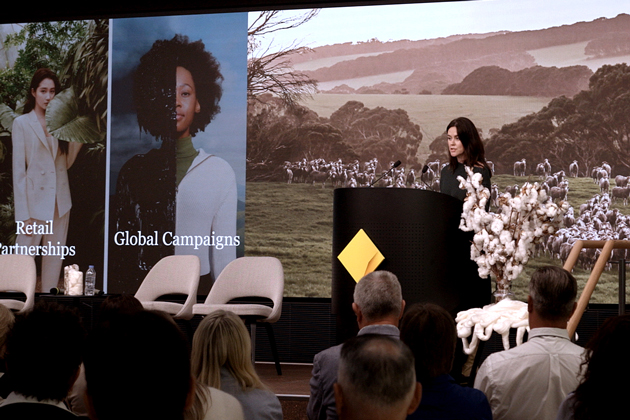
Pictured: Woolmark's Head of Demand Creation, Laura Armstrong addresses attendees at the inaugural Australian Natural Fibres Forum.
Wool may begin its journey in the shearing shed, but its future is increasingly being shaped in design studios, digital marketplaces and performance apparel collections around the world.
Speaking on The Yarn podcast, AWI/Woolmark’s Head of Demand Creation, Laura Armstrong, outlined how her team is helping position wool at the intersection of fashion, performance and sustainability.
From emerging designers and elite athletes to major online retail platforms in China, the strategy is focused on ensuring wool remains relevant in a rapidly evolving textile and consumer landscape.
One example Armstrong pointed to was American fashion designer Raul Lopez, a finalist in the International Woolmark Prize, who later designed a Merino wool collection worn by tennis champion Venus Williams at the US Open.
Armstrong explained that Woolmark worked closely with Lopez through the Woolmark Prize program, supporting sourcing, development and wool collection creation as part of a broader strategy to foster emerging design talent.
“He absolutely fell in love with wool through the Woolmark Prize,” Armstrong said.
When Lopez was approached to create a high-performance on-court look for Williams, Armstrong said wool became central to the project because of its ability to combine aesthetics with technical performance.
“Woolmark didn’t have to have any financial contribution to someone like Venus Williams, who would be out of our reach financially, but that is such an incredible ambassador for the fibre,” Armstrong said.
The example reflects a broader shift occurring within wool marketing globally, where performance and versatility are becoming increasingly important alongside luxury and natural fibre credentials.
Armstrong said Woolmark’s growing engagement with online retail platforms is also providing valuable insight into changing consumer behaviour.
In China, Woolmark partners with major online shopping platform Tmall to deliver Wool Week, a large-scale digital shopping campaign built around the country’s major online retail calendar events.
Last year’s campaign aggregated more than 5,000 brands on the platform and generated more than 300 million page views during the week-long promotion.
But Armstrong said the real value extends beyond visibility.
“For us, really, the most valuable part of that whole program is not really the reach, it’s the insights,” she said.
By working closely with online retail platforms, Woolmark can monitor purchasing behaviour and identify emerging trends in real time.
One of the strongest signals to emerge has been growing consumer demand for lighter-weight wool apparel and performance-focused garments.
“We have grown wool performance wear through Wool Week by 56 per cent. It’s the fastest-growing category within Wool Week,” Armstrong said.
The growth has become significant enough that Tmall is now exploring a dedicated performance wool shopping promotion independently.
Armstrong said these insights are then fed back to brand partners to help shape future product development and better align wool products with evolving consumer expectations.
Alongside performance wear, sustainability continues to play a major role in Woolmark’s consumer strategy.
Armstrong said Woolmark’s “Wear Wool, Not Fossil Fuel” and “Wear Wool, Not Waste” campaigns emerged following research showing many consumers simply did not understand the difference between synthetic and natural fibres.
“The research actually was really enlightening because we discovered that consumers, they really just didn’t know how materials were made,” Armstrong said.
“When we explained to them this is how synthetic materials are made from fossil fuel and plastic, when that penny dropped, you could see a lot of them were very shocked and embarrassed.”
Armstrong said that discovery fundamentally shifted Woolmark’s consumer marketing approach toward education and clarification around fibre choice, sustainability and textile impact.
The broader retail landscape, however, continues to evolve rapidly.
Armstrong acknowledged ongoing pressure across the global retail sector, including shifting department store models, challenging conditions for emerging brands and increasing competition across apparel categories.
Despite that volatility, Armstrong said Woolmark’s role remains focused on helping wool maintain relevance and desirability in international markets where the overwhelming majority of Australian wool is ultimately sold.
Through designer partnerships, digital retail campaigns, performance apparel development and consumer education, Woolmark’s strategy continues to position wool not simply as a traditional natural fibre, but as a modern material capable of meeting the demands of a changing global market.
This article appeared in the AWI Woolgrower Newsletter June 2026. Reproduction of the article is encouraged and should be attributed as follows: This article was first published in the AWI Woolgrower Newsletter.