




Wool supply contraction reflects adverse seasonal conditions and higher sheep turnoff

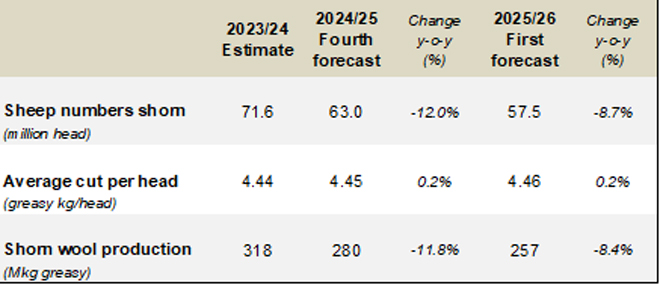
The Australian Wool Production Forecasting Committee (AWPFC) has updated its forecast of shorn wool production for the 2024/25 season. The fourth forecast is for production of 280.1 million kilograms (Mkg) greasy. This is 11.8% lower than the 2023/24 season estimate.
- The latest Australian Wool Production Forecasting Committee’s forecast of shorn wool production for 2024/25 is 280.1 Mkg greasy, an 11.8% decrease on the 2023/24 estimate.
- The number of sheep shorn in 2024/25 is forecast at 63.0 million, down 12.0%.
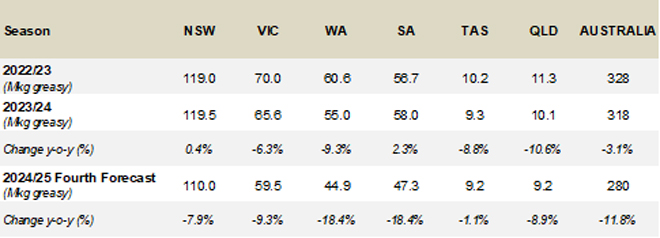
- Shorn wool production is expected to decrease in all states.
- Average cut per head is expected to be comparable with 2023/24 at 4.45 kg greasy, down 0.2%.
- The AWPFC’s first forecast of shorn wool production for the 2025/26 season is 256.6 Mkg greasy, an 8.4% decrease on the 2024/25 forecast.
The Australian Wool Production Forecasting Committee (AWPFC) has updated its forecast of shorn wool production for the 2024/25 season. The fourth forecast is for production of 280.1 million kilograms (Mkg) greasy. This is 11.8% lower than the 2023/24 season estimate.
Committee Chairman, Stephen Hill said that "the revised forecast reflects the continuing drought conditions in western Victoria and South Australia and a decrease in the number of sheep shorn and shorn wool production in all states. Commodity prices, input costs and variable seasonal conditions continue to impact sheep producers’ decisions regarding their enterprise mix, particularly in Western Australia where wool test volumes and first-hand auction offerings were down by 17.8% and 21.2% respectively to the end of March.”
“Whilst Queensland produces about 3-5% of the national clip, the recent major flood event will have a significant negative impact in that state’s key wool producing regions with major damage to infrastructure, including exclusion fencing and substantial stock losses.”
The committee is forecasting a decline in production for all states ranging from over 18% in WA and SA to 1.1% in Tasmania.
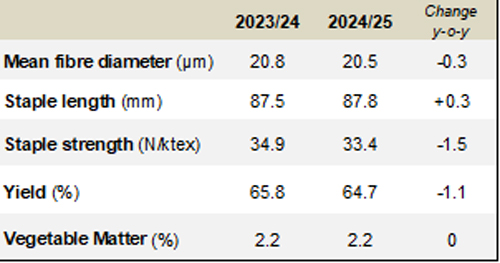
Average cut per head is forecast to be comparable with 2023/24, at 4.45 kg greasy (down 0.2%). AWTA key test data for the 2024/25 season to the end of March show small year-on-year reductions in mean fibre diameter (down 0.3 microns), staple strength (down 1.5 N/ktex) and yield (down 1.1%). Staple length was 0.3 mm longer with no year-on year change in vegetable mater (2.2%).
AWTA wool test volumes for the 2024/25 season to the end of March were down by 8.9% on a year-on-year basis. Firsthand offered wool at auction during 2024/25 to end of March were down by 9.1%.
Sheep slaughter from July to December 2024 was up 29% compared with same time in 2023 and was 58% above the five-year July to December average.
The AWPFC’s first forecast of shorn wool production for the 2025/26 season is 257 Mkg greasy, an 8.4% decrease on the 2024/25 forecast.
The AWPFC awaits the updated ABS sheep flock estimates which are expected to be released in mid-June. They will be included in the information considered by the AWPFC State and National Committees when they next meet to revise their shorn wool production forecasts for 2024/25 and 2025/26.
Table 1: Summary of Australian wool production
Note: Totals may not add due to rounding.
Table 2: Total shorn wool production by state
Note: Totals may not add due to rounding.
Table 3: AWTA key test data for 2023/24 and 2024/25 (July to March)
The National Committee drew on advice from the six State Committees, each of which includes growers, brokers, private treaty merchants, sheep pregnancy scanners, representatives from State Departments of Agriculture and the Australian Wool Testing Authority. Data and input were also drawn from AWEX, wool exporters, the Australian Bureau of Statistics, ABARES and Meat and Livestock Australia.
The state and national Committees will next meet in mid-August 2025.
The full forecast report will be available on the AWI website at www.wool.com/forecasts from 9 May 2025.
Released by:
Kevin Wilde
Australian Wool Innovation, General Manager, Consultation and Engagement
Mobile: +61 436 031 277