




Australian Wool Production Forecast Report August 2026
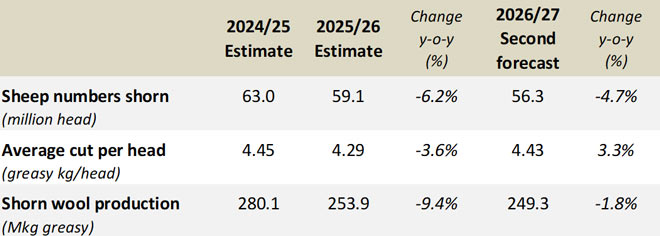
The Australian Wool Production Forecasting Committee’s (AWPFC) second forecast of shorn wool production for the 2026/27 season is 249.3 Mkg greasy, representing a 1.8% decrease on the estimated 253.9 Mkg greasy produced in 2025/26. Sheep shorn numbers are forecast to remain historically low at 56.3 million head, down 4.7% on 2025/26.
Summary
The Australian Wool Production Forecasting Committee’s (AWPFC) second forecast of shorn wool production for the 2026/27 season is 249.3 Mkg greasy, down 1.8% from the estimated 253.9 Mkg greasy produced in 2025/26. Sheep shorn numbers are forecast to fall 4.7% to 56.3 million head, remaining at historically low levels.
- National flock numbers appear to have stabilised, with any near-term flock growth likely to be driven by on-farm breeding rather than the purchase of replacement ewes due to high breeding stock prices.
- Seasonal conditions have improved since the April forecast, with widespread rainfall across South Australia, Victoria and Western Australia supporting feed availability and producer confidence. Conditions remain mixed in New South Wales and challenging in Tasmania and parts of Queensland.
- The Bureau of Meteorology outlook for September to November 2026 indicates below average rainfall is likely across south-west WA, south-east SA, Victoria, Tasmania and parts of NSW and southern Queensland, while above average rainfall is forecast for much of Western Australia; temperatures are expected to be above average across most of Australia.
- Spring rainfall will be critical to supporting flock rebuilding through improved feed and water availability. However, ongoing cost pressures and a drier seasonal outlook are expected to temper producer confidence and encourage cautious management decisions.
- Results from the May 2026 Sheep Producer Intentions Survey indicate improved producer confidence, supported by stronger sheepmeat and wool markets. More producers intend to retain stock, rebuild flocks and increase breeding ewe numbers.
- The 2026/27 outlook follows an estimated shorn wool production of 253.9 Mkg greasy in 2025/26, down 9.4% from 2024/25 and 1.5 Mkg below the April forecast.
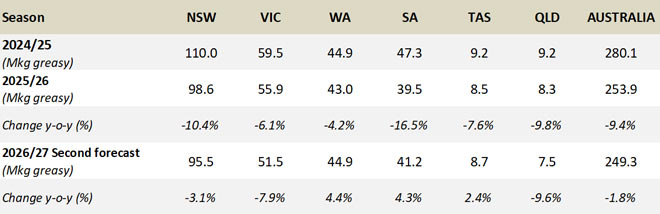
- Shorn wool production declined across all states in 2025/26, ranging from 4.2% in Western Australia to 16.5% in South Australia. New South Wales remained the largest wool producing state at 98.6 Mkg greasy, followed by Victoria (55.9 Mkg greasy), Western Australia (43.0 Mkg greasy), South Australia (39.5 Mkg greasy), Tasmania (8.5 Mkg greasy) and Queensland (8.3 Mkg greasy).
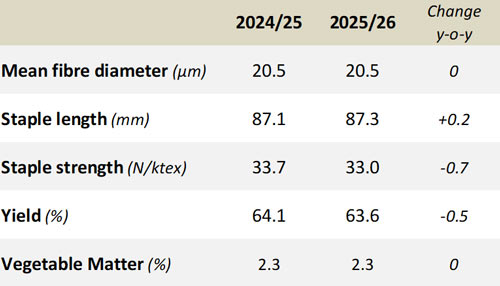
- Average cut per head was estimated at 4.29 kg greasy, down 3.6% on 2024/25. AWTA Key Test Data showed unchanged mean fibre diameter (20.5 µm) and vegetable matter (2.3%), with staple length increasing to 87.3 mm, while staple strength and yield declined slightly.
- AWTA wool test volumes for the 2025/26 season were 271.7 Mkg greasy, down 8.0% year-on-year. First-hand wool offered at auction totalled 253.9 Mkg greasy, down 1.7%.
- Sheep slaughter in 2025/26 fell 31% to 8.04 million head, while lamb slaughter declined 15% to 22.07 million head. Both sheep and lamb slaughter were below their respective five-year averages.
- Table 1 summarises Australian wool production and Table 2 shows the total shorn wool production by state. Table 3 provides a comparison of AWTA key test data for the 2024/25 and 2025/26 seasons.
The AWPFC adopted the ABS flock estimates released in December 2025, which included revised national flock figures from 2016/17 onwards that reflect the change in scope to capture all sheep grown for commercial gain in Australia.
- More detailed information on the shorn wool production by state in 2025/26 can be found in Table A1 in the Appendix to this report.
- The Appendix also provides historical data for Australia, including sheep shorn numbers, average cut per head and shorn wool production (Table A2) as well as the micron profile (Table A3) since 1991/92.
Historically low sheep numbers drive modest decline in 2026/27 wool production.
Committee Chairman Stephen Hill said, “While the national flock appears to have stabilised, any near-term growth is likely to be driven by on-farm breeding programs rather than purchases of replacement ewes, as breeding stock prices remain high. Further spring rainfall will be critical to improving feed and water availability and supporting flock rebuilding intentions across key wool-producing regions. At the same time, ongoing cost pressures and the drier seasonal outlook are likely to temper producer confidence and encourage cautious decision-making in the months ahead.”
The May 2026 Sheep Producer Intentions Survey indicated producer sentiment towards the wool industry rebounded strongly, with net sentiment rising 80 points year-on-year. The improvement was driven by stronger wool market conditions and a shift in producer focus from risk management and flock reduction towards stock retention and flock rebuilding. However, seasonal conditions and the weather outlook remained the dominant factors influencing on-farm decision making.
Mr Hill added that “Seasonal conditions have improved significantly since our April forecast, with widespread rainfall across South Australia, Victoria and key wool-producing regions in Western Australia boosting feed availability and producer confidence. However, conditions remain mixed in New South Wales, Australia’s largest wool-producing state, while Tasmania and parts of Queensland continue to face seasonal challenges”.
The outlook for 2026/27 follows an estimated shorn wool production of 253.9 Mkg greasy in 2025/26, which was 9.4% lower than in 2024/25 and 1.5 Mkg below the April forecast.
The Committee has estimated year-on-year declines in shorn wool production across all states in 2025/26. These declines range from 16.5% in South Australia (down to 39.5 Mkg greasy) to 4.2% in Western Australia (down to 43.0 Mkg greasy). New South Wales produced 98.6 Mkg greasy (down 10.4%), Victoria 55.9 Mkg greasy (down 6.1%), Tasmania 8.5 Mkg greasy (down 7.6%) and Queensland 8.3 Mkg greasy (down 9.8%).
Average cut per head was estimated at 4.29 kg greasy, 3.6% lower than 2024/25. AWTA Key Test Data for the 2025/26 season show no change in mean fibre diameter or vegetable matter (20.5 µm and 2.3% respectively), a 2 mm increase in staple length to 87.3 mm with reductions in staple strength (down 0.7 N/ktex to 33.0 N/ktex) and yield (down 0.5% to 63.6%).
AWTA wool test volumes for the 2025/26 season were 271.7 Mkg greasy, down 8.0% year-on-year. First-hand wool offered at auction during 2025/26 was down 1.7% at 253.9 Mkg greasy.
Sheep slaughter for 2025/26 was down 31% to 8.04 million head with lamb slaughter at 22.07 million head (down 15%) compared to 2024/25. The 2025/26 sheep and lamb slaughter were both lower than the five-year average by 5% and 6% respectively.
The reduction in sheep and lamb turn-off during 2025/26 suggests the national flock is stabilising, while improved producer sentiment provides the potential for future growth. Seasonal conditions during spring and early summer will remain a key determinant of flock rebuilding activity. Despite ongoing cost pressures, wool producers appear increasingly focused on rebuilding flocks through on-farm breeding programs and greater retention of breeding stock.
The AWPFC adopted the ABS flock estimates released in December 2025, which included revised national flock figures from 2016/17 onwards that reflect the change in scope to capture all sheep grown for commercial gain in Australia.
Table 1: Summary of Australian wool production
Note: Totals may not add due to rounding.
Table 2: Total shorn wool production by state
Note: Totals may not add due to rounding.
Table 3: AWTA key test data for 2024/25 and 2025/26 (Full season)
The National Committee drew on advice from the six State Committees, each of which includes growers, brokers, private treaty merchants, sheep pregnancy scanners, representatives from State Departments of Agriculture and the Australian Wool Testing Authority. Data and input were also drawn from AWTA, AWEX, wool exporters, the Australian Bureau of Statistics, ABARES, the Bureau of Meteorology and Meat and Livestock Australia.
The state and national Committees will next meet in mid-December 2026.
The full forecast report will be available on the AWI website at www.wool.com/forecasts from 4 September 2026.
Released by:
Kevin Wilde
Australian Wool Innovation, General Manager, Consultation and Engagement
Mobile: +61 436 031 277