




Alternative water sources – is capturing runoff an option?
Are you facing water shortages and need to consider alternative methods of on-farm water supply? Traditionally, capturing run off has involved constructing dams across catchments or watercourses. Producers are now exploring a range of alternative methods for capturing runoff.
Author: Jodie Reseigh-O'Brien, Project Manager, AWI Extension SA
Many producers are facing water shortages due to extended dry periods, particularly those without access to mains or scheme water. As these pressures increase, the need to secure alternative onfarm water supplies has become more urgent.
Traditionally, capturing run off has involved constructing dams across catchments or watercourses within regulatory requirements and with consideration for the environment and other water users. Producers are now exploring a range of alternative methods for capturing runoff.
Most producers capture runoff from houses and sheds, however capturing the runoff from hard pads adjacent to shedding has proven successful for many producers. Depending on the final use of the water, silt traps and flocculants may be needed to improve water quality.
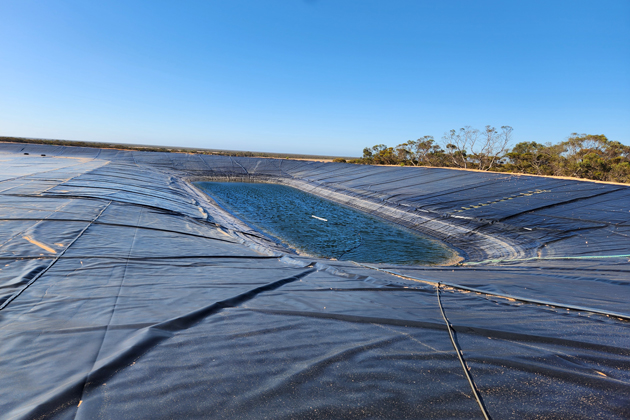
Other options for water capture include graded or sheeted catchments. These catchments are an area of land that is specifically managed to maximise water catchment and run-off into a dam. When considering catchments several factors must be taken into account:
- relevant approvals
- the type of catchment (graded or sheeted)
- size
- rainfall – average annual total, intensity of rainfall events and seasonality to create runoff estimates
- siting – slope of the ground and proximity to where water will be used
- how captured water will be stored.
- These factors influence both construction costs and ongoing maintenance requirements.
When thinking about installing a catchment, it is recommended to visit existing catchments, talk to the owners and undertake your own research (see further information section for suggestions). The considerations outlined below are not exhaustive but provide a useful starting point.
It is important that you contact your local authorities, including natural resource management and local government for information and advice on permits and approvals for any proposed catchment.
There are several ways to establish a catchment, some make use of existing infrastructure, such as existing roads or smooth rock outcrops, or involve constructing an unlined graded catchment or a plastic-lined catchment.
The amount of run off is dependent on the type of catchment. For unlined catchments, including roads, the amount of run off is dependent on exposing and rolling less permeable clay soils, with run off estimates of 5–40%. Where existing rock outcrops act as the catchment, run off estimates are 45–50%. For plastic sheeted catchments constructed of welded plastic sheets or where the catchment area is bituminised, runoff estimates are 75–90%.
Rainfall amount and seasonality will affect the size of catchment needed to collect the required supply of water. Rainfall intensity will influence construction technique – areas with predominately low intensity, intermittent rainfall are less suitable for compacted earth/hardstand catchments.
Other important considerations include siting the catchment in an elevated area to help reduce pumping costs; ensuring that there is sufficient room to expand the catchment in the future if required; and avoiding steep ground – a level area with a gentle slope is best.
Fencing of the catchment and storage dam is recommended to prevent livestock and wildlife damaging the catchment. Catchment and dam liner considerations should include the length of the warranty and safety of people – lined dams are very slippery so a ladder or safety rope should be installed. If the dam is to be used for long term water storage, consider the amount of evaporation from the dam, how this may be minimised and how algae growth will be minimised.
Catchments are not necessarily a low-cost water option, but costs can be reduced with some careful planning.
More information
More information and case studies on capture, storage and management of water:
- PIRSA Eyre Peninsula Farm Water Security Project case studies and fact sheets
- Coorong District Council Water security
- DPIRD WaterSmart Farms
This article appeared in the AWI Woolgrower Newsletter March 2026. Reproduction of the article is encouraged and should be attributed as follows: This article was first published in the AWI Woolgrower Newsletter.