




Why can’t we do more with crossbred wool?
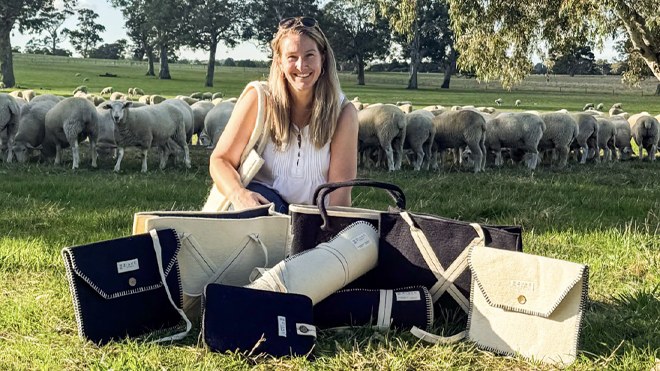
For ZIAKE founder Bec Malseed, that question became the fire in her belly.
Bec speaks with the same energy and curiosity that first pushed her to challenge what broader wool could become.
Working alongside sheep producers, consultants and veterinarians across south-west Victoria during her time managing Lifetime Ewe Management (LTEM), Bec repeatedly heard the same frustration from crossbred woolgrowers.
“It’s costing us more to shear than what we’re getting on our return for wool.”
At the same time, she could see the quality of the fibre sitting in front of her.
“Farmers, they’d pull their fleeces out and you’d look in and it’s beautiful and white. It’s just broader-type wool,” Bec said.
Why would you want to put this beautiful white wool where your feet are going to walk on it?”
For Bec, it highlighted a broader question around how crossbred wool had traditionally been viewed – often directed into carpets, upholstery and lower-value applications despite the quality of the fibre itself.
That question became the beginning of ZIAKE – a brand built around finding new ways to value-add Australian crossbred wool and increase potential returns for growers.
While LTEM provided valuable exposure to sheep production systems and grower conversations, Bec said the experience also highlighted an opportunity to think more broadly about how stronger wool types could be utilised.
“There was a real frustration amongst producers,” she said. “But it also made me think – why can’t we do more?”
Rather than positioning crossbred wool against finer apparel wool, Bec sees the opportunity as complementary.
“My brand is not about competing,” she said. “I don’t want to compete with Merino wool brands or Merino products or supply chains. “I want to build a collaboration where my products can actually work harmoniously with a Merino product that’s already in place.”
That philosophy now sits at the centre of ZIAKE’s product development – using broader wool in outerwear, bags and accessories, while embracing natural fibres and biodegradability throughout the design process.
For Bec, the concept extends well beyond fashion alone. It is about changing the way people think about broader wool and challenging assumptions around where and how it can be used.
“As a consumer, my mindset is now open to wherever there is a fabric-type product – why can’t we use wool for it?” she said.
That thinking has shaped every layer of the ZIAKE brand, from wool outerwear through to biodegradable design choices, including natural fibre linings and wooden buttons in place of plastic or synthetic alternatives.
“I really want to make sure that at the end of the day I can say you can go and put it in your garden, and it’ll biodegrade over time,” Bec said.
“I don’t want plastic buttons on it. That goes against everything about wool.”
The idea gained momentum after Bec travelled to New Zealand to better understand how stronger wool types were being utilised overseas.
What she found shifted her thinking. “They’ve challenged the barriers of what could be done with Merino wool and said, ‘Well let’s now try it with crossbred wool – and what could that look like?”
The trip also reinforced how innovation and manufacturing investment could help create new demand for broader wool.
“New Zealand seems so much more advanced in their manufacturing innovation and use of broader wool,” Bec said. “Why couldn’t we do it?”
Bec said seeing wool used in insulation, architectural products and other non-traditional applications reinforced the broader opportunity for Australian wool.
“They’re thinking outside the box,” she said. Back in Australia, Bec began building the ZIAKE supply chain – a process she says was strongly supported by Australian Wool Innovation (AWI).
“AWI helped me source the supply chain,” she said. “They couldn’t do enough for me to find manufacturers and help me build this.”
Bec said it was important growers understood the role levy-funded industry support could play in creating future opportunities.
She said many broader woolgrowers she worked alongside during her LTEM days often questioned where their levies were being invested, particularly when returns for crossbred wool remained challenging.
“There was a real frustration amongst producers,” she said. “They’d say, ‘AWI take our levies, but we’re not getting anything back in return. It’s all focused-on Merino wool.’”
However, through building ZIAKE, Bec said she gained a firsthand understanding of the role AWI could play in helping connect growers, brands and supply-chain opportunities.
“AWI helped my brand by connecting with the manufacturers in the supply chain,” she said. “AWI helped with introductions to overseas manufactures in different countries.
Without their help, I’m not sure I would have achieved the progress of where I am today.”
Bec said it was important growers understood the value of industry investment across the broader supply chain.
“Your levies actually helped create a potential new value-adding opportunity with crossbred wool,” she said.
But while support and connections helped open doors, the process of building a brand from scratch has also come with significant challenges. One of the biggest came early, when Bec’s first wool shipment to India, the ship caught fire while at sea.
“My very first wool export experience, the vessel caught on fire,” she said.
Rather than stopping entirely, Bec pivoted – asking manufacturers to source Australian wool of similar specifications already within India so production could continue.
“It was a resilience-building exercise,” she said. “You’ve got to stop, take the emotion out and just pivot and problem solve it.”
That practical mindset continues to shape the business as Bec prepares future collections and gathers feedback directly from growers and consumers.
“This year is my test-and-trial era,” she said. “I want feedback. I want people to tell me what they love, what they’d change and how we can improve it.”
At the heart of the brand is also a strong focus on reconnecting consumers with fibre provenance and the people behind it.
“The whole point of the brand is creating that farmer-to-consumer connection, a circular economy,” Bec said. “they know where their wool has come from.”
Bec believes consumers are increasingly looking for products with longevity, sustainability and purpose – particularly as awareness grows around synthetic fibres and landfill.
“Consumers are becoming more aware and mindful of their footprint when they purchase products” she said. “There are now better alternatives and ZIAKE is one of them.”
For Bec, the ambition extends beyond a single brand or collection. It is about creating more pathways for wool; more demand for this incredible fibre and more opportunities for growers into the future.
“This is part of the big picture,” she said. “We (all wool brands in Australia and overseas) have to collaborate and come together and make this a massive push for wool and natural fibres.”
Her final message is simple. “If you can make a difference, you must try.”
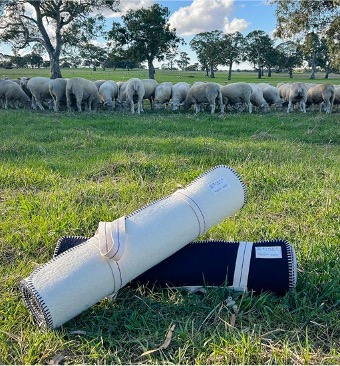
The fitness mat provides a soft surface that feels luxurious underfoot while maintaining durability through regular use.
MORE INFORMATION
This article appeared in Issue 106 of AWI’s Beyond the Bale magazine that was published in September 2026. Reproduction of the article is encouraged and should be attributed as follows: This article was first published in Issue 106 of AWI’s Beyond the Bale magazine.