




The industry’s quiet champion
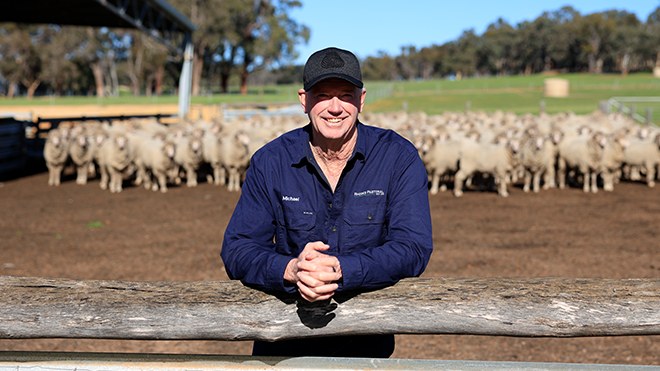
From championing Merino wool and mentoring future leaders to investing in training and innovation, Michael Wright has become one of the Australian wool industry’s most respected advocates.
Above: Rhodes Pastoral General Manager Michael Wright has spent much of his career championing Merino wool, mentoring future leaders and encouraging the industry to tell its story with confidence.
Spend an hour in conversation with Michael Wright, General Manager of Rhodes Pastoral, and it quickly becomes apparent the discussion isn’t really about the business at all.
Based across approximately 17,500 hectares in the Boyup Brook, Arthur River and Kojonup districts of Western Australia’s south-west, Rhodes Pastoral is one of the state’s leading mixed farming enterprises, running around 23,000 Merino ewes alongside cropping, cattle and a White Suffolk stud.
Yet despite the scale of the operation, Michael’s attention rarely stays on Rhodes Pastoral for long. Instead, the conversation inevitably returns to the same subject.
The future of Australian wool.
It is a conversation he has been having for much of his career. Whether mentoring young producers, investing in leadership, embracing new technology or simply speaking positively about Merino wool whenever the opportunity arises, Michael has quietly become one of the industry’s strongest advocates.
“I think wool's got a great future,” he said simply.
It isn’t a throwaway comment. It is a philosophy that underpins everything he does.
After decades in agriculture, Michael has experienced fluctuating markets, difficult seasons and an industry that has continually evolved. Yet rather than dwelling on the challenges, he speaks with genuine optimism about the opportunities ahead.
“The younger generation is figuring out they want clothing that’s more sustainable,” he said. “I think they’re realising how good wool is.”
That optimism is grounded in experience, backed by commercial success and reinforced by a lifelong commitment to strengthening the Merino industry.
It is also what has made Michael one of wool’s quiet champions – not through grand statements or high-profile roles, but through practical leadership, generous advocacy and an unwavering belief that Australian wool has one of the best stories in agriculture.
“We’ve got a great story. The industry just needs to tell it better.”
A voice for wool
Michael’s advocacy for the wool industry comes from a genuine belief that every woolgrower has a responsibility to help shape the industry’s future.
Throughout the conversation, he repeatedly shifted the focus away from his own achievements and back towards the opportunities facing Australian wool. Rather than dwelling on challenges, he speaks about solutions.
Rather than waiting for change, he encourages producers to become part of it.
For Michael, advocacy is about far more than identifying problems. It is about rolling up your sleeves. That philosophy has seen him invest countless hours into industry leadership, community service and professional development throughout his career.
Alongside managing one of Western Australia’s most progressive mixed farming enterprises, Michael has completed the CEO Institute leadership program, participated in the Australian Rural Leadership pathway, contributed to industry committees, served on local council and continues mentoring the next generation of agricultural leaders.
Each experience has reinforced one belief. Leadership is about bringing people together.
“Constructive criticism is important,” he said. “But you’ve also got to be prepared to get involved.”
It is a simple philosophy, but one that has shaped the way Michael approaches almost every aspect of his career.
Putting production into perspective
One of the most memorable moments of the conversation came when Michael stopped talking about sheep altogether. Instead, he started talking about numbers. Numbers that anyone and everyone could understand. Rhodes Pastoral currently manages around 23,000 Merino ewes, alongside a White Suffolk stud, approximately 750 Angus breeders and 5,000 hectares of cropping.
The business produces around $7,000 worth of wool every day at current market prices.
Curious about the broader contribution of the enterprise, Michael recently entered the farm’s production figures into an artificial intelligence program.
The result surprised even him.
“It came back and said we produce enough food and fibre to feed between 55,000 and 60,000 people.”
For Michael, those figures aren’t about celebrating the size of the business. They’re about changing the conversation around agriculture. “We’re feeding people,” he said. “But we are not that great at marketing ourselves.”
It is a sentiment that surfaced repeatedly throughout the interview. Australian farmers, he believes, are incredibly good at producing food and fibre. They are far less comfortable telling people about it. “The only time we’re in the media is when there’s bad news,” he said.
Michael believes the industry often talks in language that resonates with other producers but means very little to consumers.
Instead, he believes agriculture needs to become better at translating its impact into stories that connect with the broader community. He points to one recent example.
A single B-double load carrying 650 Merino lambs left Rhodes Pastoral earlier this year, averaging $265 a head – more than $170,000 worth of livestock on one truck.
Likewise, every semi-trailer carrying wool away from the property represents years of breeding decisions, pasture management, animal husbandry and seasonal risk. “When that wool leaves the farm that’s a piece of your property going with it,” he said.
It is a simple observation. Yet it perfectly captures the way Michael views agriculture.
Every bale of wool tells a story. Every truckload of sheep represents years of investment.
Every fleece carries with it the work of the people and landscapes that produced it.
For Michael, these are the stories Australian agriculture needs to tell more often. Not because producers are looking for recognition. But because consumers increasingly want to understand where their food and clothing come from.
And no industry is better placed to tell that story than Australian wool.
Rhodes Pastoral
- 17,500 hectares across Boyup Brook, Arthur River and Kojonup, WA
- 23,000 Merino ewes
- 750 Angus breeders
- 5,000 hectares of cropping
- Produces around $7,000 worth of wool every day
- Produces enough food and fibre to support an estimated 55,000–60,000 people
- Held approximately 3,000 bales of wool during the market downturn as part of a long-term marketing strategy
Telling the Merino story better
If there was one message Michael returned to more than any other during the interview, it was this: The wool industry has a great story. The industry just needs to tell it better.
When he first entered agriculture more than four decades ago, there was a far stronger connection between rural and urban Australia. Today, he believes that relationship has changed dramatically.
“When I started farming, there was a connection between the city and the bush,” he said. “Now that disconnect has really grown.”
For Michael, rebuilding that connection represents one of the industry’s greatest opportunities. Not by asking consumers to simply buy wool. But by helping them understand why wool matters. Natural. Renewable. Biodegradable. Ethically produced. Continually improving.
“We produce ethically grown, sustainable Merinos,” he said. “And we’re always trying to improve.”
Keeping Merinos relevant
One of Michael’s more memorable observations during the interview came with a smile.
“We’ve just got to make sheep sexy again.”
It was a light-hearted comment, but behind it sat a serious message. What Michael was really talking about was relevance. He believes today’s Merino industry already has everything consumers and young producers are looking for – innovation, technology, sustainability and continual improvement. The challenge is making sure people know it.
Today’s sheep enterprises are built on genomics, electronic identification, performance recording and data-driven decision making.
“Technology is getting very savvy now,” he said. “We’ve got to change with the times.”
At Rhodes Pastoral, that commitment to continual improvement drives every decision, from genetics and pasture management through to animal welfare.
For Michael, those advances are part of a much bigger story. Australian woolgrowers are producing a natural, renewable fibre while continually improving the way it is grown.
“We’re always trying to improve,” he said. “It’s genetics, it’s feeding, it’s welfare. Everything is connected.”
“When that wool leaves the farm, that's a piece of your property going with it.”
Backing wool with confidence
Michael’s confidence in wool is grounded in commercial reality. Like many growers, Rhodes Pastoral weathered the market downturn by holding around 3,000 bales of wool for almost three years – a calculated decision that reflected a long-term view of the industry.
“It was a risk,” he said. “But every business is different.”
That optimism extends well beyond the farm gate. As consumers increasingly seek natural and sustainable products, Michael believes wool is perfectly placed to meet that demand. Rather than seeing synthetic fibres purely as competition, he sees an opportunity.
Every garment that incorporates wool, even in a blend, introduces consumers to the fibre’s natural performance and sustainability credentials.
He also believes Australian wool has much to gain by aligning more closely with the country’s internationally recognised red meat industries. “We need to get on the coattails of the meat side,” he said. “Look at the Merino. Look what it produces.”
For Michael, the Merino ewe remains one of agriculture’s great production animals – producing both premium wool and high-quality lamb while underpinning profitable, resilient farming businesses.
One of the industry’s quiet champions
For all the discussion about Rhodes Pastoral, Michael’s attention rarely stayed on his own business for long.
Every conversation eventually returned to the same place. The future of Australian Merino wool.
Whether through mentoring young producers, investing in leadership, supporting industry training or simply speaking positively about wool whenever the opportunity arises, Michael has spent much of his career advocating for an industry he believes in.
Not because anyone asked him to.
But because he believes every producer has a role to play in shaping its future.
“We’ve got a great story,” he said.
Spend an hour with Michael Wright and it’s hard not to believe him.
His optimism is genuine, his advocacy unwavering and his belief in Australian wool unmistakable.
In many ways, Michael represents the kind of leadership the Merino industry has always relied upon – quiet, practical and deeply committed to leaving the industry stronger than he found it.
This article appeared in Issue 106 of AWI’s Beyond the Bale magazine that was published in September 2026. Reproduction of the article is encouraged and should be attributed as follows: This article was first published in Issue 106 of AWI’s Beyond the Bale magazine.