





NEW SURFACES - A new market for wool

For woolgrowers, faux fur represents more than a new look. It is an additional offering that can put wool into more products and more markets, broadening the fibre's demand base across fashion, lifestyle, outdoor and performance categories.
There was a time when faux fur existed purely as imitation - a substitute designed to replicate the appearance of traditional fur. That conversation is changing. Today, the opportunity is to create entirely new textile surfaces, and wool is giving manufacturers a natural, renewable fibre with which to do it.
As fashion continues to move away from tradition-al animal fur, brands and consumers still seek warmth, volume, softness and a sense of luxury. Wool faux fur answers that need in a different way. Rather than relying solely on synthetic fibres, it uses wool to create pile and plush fabrics with their own character, performance and material integrity. For growers, that means another reason for designers and manufacturers to specify wool – and another potential source of demand alongside wool’s established uses.
From fleece to a new market
At the fibre level, wool brings qualities that synthetic faux fur cannot fully match. Its natural thermal performance, resilience, softness and moisture management can create surfaces that are voluminous yet lightweight, warm yet comfortable. Those familiar attributes of a well-grown fleece are being translated into a new generation of products.
Wool faux fur fabrics can be made through weft knitting, warp knitting, weaving or tufting, then cropped and brushed to achieve different pile effects. Inlay knitting, terry or plush knitting and sliver knitting are among the methods used to build texture and depth. The result may evoke fur or shearling, but it is a textile construction in its own right – one that expands the ways wool can deliver comfort, performance and luxury.
The distinction matters. Wool fleece is seasonally shorn and regrows naturally, year after year, through a mix of grass, sunshine and water. By applying that renewable fibre to a category often associated with synthetics, mills can offer the market a different choice while creating a fresh pathway from the farm gate to the finished product.
Innovation that builds specification
Lanificio Becagli, an Italian mill based in Prato, shows how that pathway is developing. With more than 65 years of experience producing innovative fabrics, the mill approaches wool faux fur not as a copy of another material, but as a new material experience in its own right. Its work demonstrates how machinery, construction techniques and finishing expertise can turn wool into surfaces with distinctive visual and tactile depth.
One example described by Alessandro Becagli is a double-faced wool and alpaca blend with pile on both sides. The unlined construction balances volume with lightness, softness with structure, and emotion with performance – the kind of product innovation that gives brands a new reason to put wool at the centre of a collection.
“When wool is combined with proprietary construction techniques and advanced finishing systems, it allows the creation of fabrics that are simultaneously lightweight, thermally rich, soft and structurally expressive,” says Alessandro Becagli of Lanificio Becagli.
For woolgrowers, the commercial relevance is straightforward: every viable new construction adds to the range of products in which wool can be specified. As textile engineering and finishing processes advance, wool faux fur can help diversify the fibre’s markets rather than asking existing categories to carry the whole demand story.
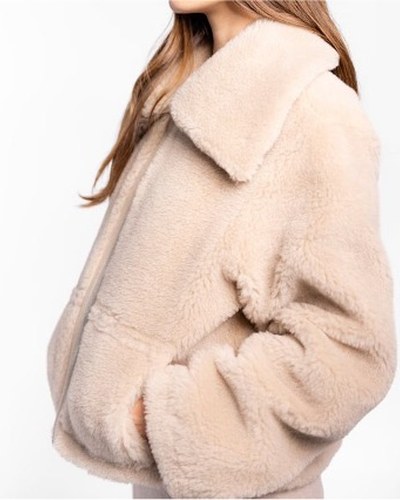
Wool faux fur is opening new possibilities for Australian wool, creating natural, renewable textile surfaces with warmth, softness, volume and tactile appeal.
More end uses, more opportunity
The opportunity is also moving beyond high-fashion statement pieces. Wool faux fur is entering performance, outdoor and lifestyle applications, where warmth, wearability and technical capability must work together. Jackets, linings, accessories and everyday pieces can each become another point of entry for wool.
Ecofur, a textile manufacturer specialising in bionic faux fur fabrics, is one example of this shift. With more than two decades of work across outdoor applications and lifestyle wear, Ecofur uses wool across micron ranges from 18.5 to 30.5, as well as wool blends with natural and bio-based fibres. That breadth is significant: it shows a category being explored across different fibre specifications and end uses, rather than being confined to a single niche.
“As long as we continue to innovate in areas such as lightweight construction and anti-shedding performance, incorporating recycled wool blends with bio-based fibres... the potential for wool faux fur in the outdoor sports market will only grow,” says Madam Chengyan Yu, General Manager and co-owner, Ecofur.
Work on lighter constructions, anti-shedding performance and fibre blends is important because it addresses the practical requirements that allow a promising material to move into wider commercial use. Each improvement can open another brief, another product and another customer for wool.
An additional demand channel
Wool faux fur is still an emerging category, and its growth will depend on continued innovation, performance and adoption by brands. Yet the direction is encouraging. Mills and manufacturers are investing in new constructions, working across a broad range of microns and taking wool into markets that extend beyond traditional apparel.
That is the real opportunity for woolgrowers. Faux fur does not need to replace an existing use of wool to be valuable; it can add to them. By giving consumers the warmth and tactile appeal they want in a natural, renewable fibre, wool faux fur creates another offering for the supply chain and another demand channel for the clip.
At the meeting point of tradition and technology, wool is not simply imitating the past. It is being engineered into something new – and every successful new surface expands the market in which wool can compete.
MORE INFORMATION
This article appeared in Issue 106 of AWI’s Beyond the Bale magazine that was published in September 2026. Reproduction of the article is encouraged and should be attributed as follows: This article was first published in Issue 106 of AWI’s Beyond the Bale magazine.