



More than a Merino producer
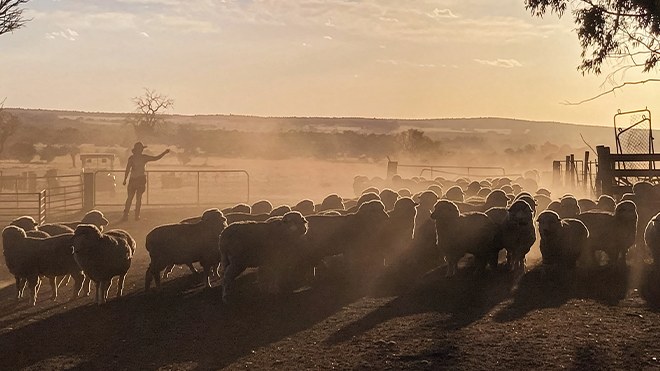
How Western Australian woolgrower Emily Stretch is helping shape the next generation of Australia’s Merino industry.
For Emily Stretch, the future of Australia’s Merino industry isn’t something to worry about.
It’s something to build. Growing up on her family’s mixed farming operation near Mobrup in Western Australia, she was the child who couldn’t wait to jump off the school bus and head straight for the shearing shed.
“I’d throw my school bag at Mum and say, ‘Bye, I’m going to the shed,’” she recalled.
It was where she felt most at home. Today, that passion remains as strong as ever.
Emily is part of a family farming business operating across around 3,800 hectares in Western Australia’s sheepbelt, producing Merino sheep alongside canola, wheat, barley, and oats. Depending on seasonal conditions, the family crops around 1,600 hectares while running between 10 to 18,000 sheep, including a breeding flock of approximately 5,000 to 6,000 Merino ewes.
It is a genuinely commercial enterprise where every decision must deliver value. After years of producing first-cross lambs, the family recently returned to a fully self-replacing Merino operation – a decision driven by both economics and confidence in the breed’s future.
“We moved back to a full Merino operation because of our passion for wool and the economic drivers within our business,” Emily said. “Crossbred wool simply wasn’t making us enough money. Our goal is to produce a productive dual-purpose Merino that delivers both wool and meat.”
That decision reflects the way Emily approaches farming. Every management decision is viewed through the lens of productivity, profitability and long-term sustainability.
“Our goal is to produce a productive dual-purpose Merino that delivers both wool and meat.”
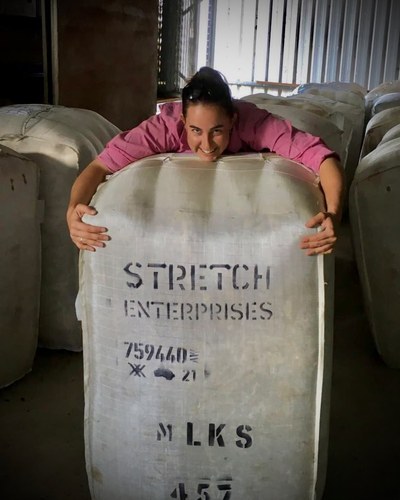
A woolgrower Emily Stretch with a bale from Stretch Enterprises. Emily combines practical farming with science and data to drive productivity across the family’s Merino enterprise.
Learning beyond the farm gate
Like many young producers, Emily didn’t know her future would eventually lead back to the family farm. The journey back to the land, however, was anything but straightforward.
Rather than immediately stepping into the business, she spent years working across different parts of agriculture – from corporate farming to pastoral stations – absorbing ideas, management styles and production systems.
Looking back, she believes those experiences shaped the producer she has become.
“One of the best things I ever did was work on other people’s farms,” she said. “You learn what works for them, what works for you and then decide what pieces are worth bringing home.”
She laughs now about returning from field days determined to implement every new idea she encountered.
Experience, however, taught her a valuable lesson. Not every innovation suits every enterprise. “There is so much information available,” she said. “But you don’t have to act on every piece of information that’s given to you.”
Instead, Emily believes success comes from understanding your own production system and selecting the practices that genuinely improve it.
Science meets practical farming
Emily describes herself as someone who walks through life with “empathy and science”.
It’s a philosophy that underpins both the family farm and the consultancy business she is now building alongside it.
Her goal is simple – helping producers work smarter, not harder.
Rather than focusing on one discipline, Emily works across whole-farm systems, helping producers identify where efficiencies can be gained and better decisions made.
“I want to create a space where people feel safe to ask questions,” she said.
“If we’re not willing to say, ‘I don’t know’, then we’re not giving ourselves the opportunity to learn.”
That curiosity has fuelled a growing passion for livestock data, parasitology and animal health.
Emily provides worm egg counting services through her consultancy and views parasite management as one of the industry’s biggest opportunities to improve productivity.
Her family also operates a fully non-mulesed Merino enterprise – something she says requires careful planning, genetics and management rather than shortcuts.
“I’ve somehow managed to combine science and laboratory work with Merinos,” she laughed. “And it helps our bottom line.”
Despite her love of data, Emily is quick to point out that numbers alone never tell the whole story. “My connection to the land and the animals usually tells me something is wrong first,” she said. “Then I go back to the science and ask why.”
The next leap forward
Emily believes the Australian sheep industry is only beginning to unlock the potential of data.
While cropping enterprises have rapidly adopted digital technologies, she believes livestock production still has significant room for improvement.
“In cropping we’ve become very good at sharing and using data,” she said. “Then we get to livestock and we’re still carrying a notebook around in our top pocket.”
She believes future productivity gains will come from measuring the right information rather than simply collecting more of it.
“We’re still working with older systems and older metrics,” she said. “The challenge is identifying the information that genuinely helps us make better decisions.”
Women quietly changing agriculture
Although Emily has become a respected voice within the sheep industry, she has never viewed being a woman in agriculture as a disadvantage. Growing up, she was surrounded by capable farming women.
“There are probably ten farms around us where daughters have come home to farm,” she said. “For me, that was just normal.”
She has, however, noticed a shift in recent years. Not because women suddenly arrived in agriculture. Because they are increasingly prepared to stand up and be heard.
“We’ve always been there,” she said. “We’re just stepping forward a little more.”
Emily believes agriculture benefits when different perspectives are welcomed.
Whether discussions centre on science, management or changing traditional practices, she approaches differing opinions with curiosity rather than confrontation.
“I always see those conversations as opportunities to learn.”
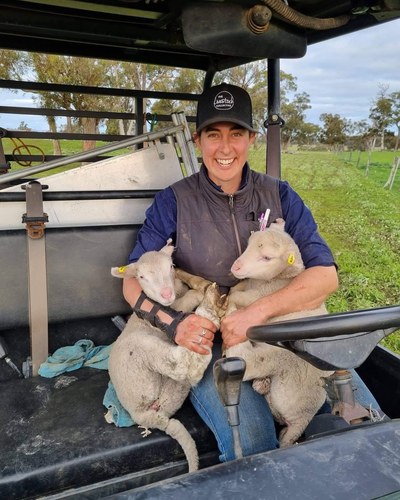
Emily Stretch believes the Merino industry is full of opportunity for the next generation – from farming and genetics to science, technology and animal health.
Looking beyond the farm gate
Emily’s willingness to embrace different ideas was reinforced during a recent Australian Wool Innovation grower visit to China. Seeing Australia’s wool transformed into premium products gave her an entirely new appreciation for the global supply chain.
“It’s not about us and them,” she said. “We’re one supply chain.”
Walking through highly automated processing facilities challenged many of the assumptions she had held before the trip and strengthened her appreciation of Australia’s relationship with one of its most important trading partners.
For Emily, the experience reinforced the importance of remaining open-minded and actively choosing collaborative approaches to our challenges – something she believes will become increasingly important for Australian producers.
A future built on opportunity
Ask Emily what excites her most about the future of wool and the answer comes quickly.
“This magical fibre is natural, biodegradable and sustainable,” she said. “The sky really is the limit.”
She also believes the Merino industry offers more career opportunities than many young people realise.
“If you love Merinos and you love Excel spreadsheets, maybe genetics is your thing,” she said. “If you love Merinos and nature, maybe you’ll become a farm manager.
“There are so many careers built on the back of the Merino industry.”
Emily doesn’t believe wool is an industry in decline.
Quite the opposite.
“There are huge areas of Australia that will always be suited to sheep,” she said.
“I don’t see it as a dying industry.
“I see it as a place full of opportunity, as long as we’re willing to stay open-minded.”
For someone equally at home in a sheep yard, behind a microscope or standing in front of a room full of producers, Emily Stretch represents something bigger than the next generation of Merino producers.
She represents the next generation of thinking.
And for the Australian wool industry, that’s an exciting place to start.
This article appeared in Issue 106 of AWI’s Beyond the Bale magazine that was published in September 2026. Reproduction of the article is encouraged and should be attributed as follows: This article was first published in Issue 106 of AWI’s Beyond the Bale magazine.