




Measuring the carbon story of wool production
A new AWI-funded research project is taking carbon measurement onto a commercial wool-growing property, with the aim of developing a practical and credible way to account for the carbon moving through Australian sheep production systems
For woolgrowers, carbon accounting is increasingly becoming part of the conversation with brands, processors and international markets. But accurately accounting for the carbon performance of a grazing enterprise is complex.
Sheep produce greenhouse gas emissions, but at the same time pastures take carbon dioxide from the atmosphere as they grow, while carbon is continually moving between plants, animals, soil and the atmosphere.
Understanding those movements – known as biogenic carbon fluxes – is the focus of a new two-year project funded by Australian Wool Innovation (AWI). The Biogenic carbon flux measurement in sheep production systems project aims to demonstrate a credible and scalable way of quantifying the net carbon footprint of Australian wool production.
Led by Agrimix in partnership with Integrity Ag, Achill Station and measurement technology company LI-COR, the project will combine direct on-farm measurement with soil, climate, pasture, livestock and farm management data.
Importantly, the work is designed to account for both sides of the carbon equation – livestock and production emissions as well as carbon flows and removals in pasture biomass and soil.
AWI Environmental Sustainability Manager Edward Fernie said increasing sustainability and reporting requirements across global textile and fashion markets meant credible evidence was becoming increasingly important.
Mr Fernie said it was important that carbon accounting reflected the whole farm system rather than livestock emissions alone.
“Grazing enterprises are biological systems, with carbon continually moving through livestock, pastures and soils. Looking at emissions alone only tells us part of the story of how carbon moves through a wool growing enterprise,” Mr Fernie said.
“The aim is to give woolgrowers a practical and more cost-effective way to understand their carbon performance, inform management decisions and demonstrate their environmental outcomes to the market.”
Measuring carbon on-farm
At the centre of the project is an eddy covariance flux tower being deployed at a commercial wool-growing property. The tower continuously measures the exchange of carbon dioxide between the land and atmosphere, providing researchers with direct information about whether the area being measured is taking up or releasing carbon over time.
Those measurements will be combined with baseline soil carbon sampling and detailed information including climate, stocking rates, pasture history and farm management.
Agrimix Research Program Manager Chloe Kempe said the aim was to build a much more complete picture of carbon movement within a commercial sheep production system.
“We’re building a carbon account that reflects the farm as a system – the sheep, the pasture and the soil – rather than looking at livestock emissions in isolation,” Ms Kempe said.
She said a grazing enterprise was a biological carbon cycle. Sheep produce greenhouse gas emissions, particularly methane, while pasture continually draws carbon dioxide from the atmosphere through photosynthesis. Some of that carbon cycles rapidly back to the atmosphere, while some can be transferred into the soil and stored for longer periods.
“If we want to understand the carbon performance of a grazing enterprise, we need to account for both sides of the ledger – the emissions being produced and the carbon moving through plants and soil.”
The challenge, she said, was to quantify those flows rigorously rather than assume that one simply offsets another.
The carbon flows will be measured across approximately 21 months, allowing researchers to better understand changes in pasture and soil carbon under Australian grazing conditions.
From one property to many
Putting sophisticated carbon-measuring equipment on every wool-growing property is neither practical nor affordable. That is why the project’s longer-term value lies not only in what is measured at the demonstration property, but in how those measurements can be used to improve carbon modelling for other wool-producing enterprises.
Data collected by the flux tower will be used to calibrate and vali-date the Agrimix Flux model for sheep and wool grazing systems.
Agrimix Flux creates a digital representation – or ‘digital twin’ – of a property using an ecosystem model alongside farm and environmental data. Once the model has been calibrated against actual measurements from the demonstration property, researchers will investigate how validated parameters could be applied to similar wool-growing systems without requiring a flux tower on every farm.
The objective is a more practical and cost-effective pathway to robust carbon reporting at an industry scale. The project will test whether measurement can be combined with a well-calibrated model so every component of the carbon cycle does not need to be physically measured everywhere, all of the time.
Ms Kempe stressed that this is the opportunity being investigated, and the approach still needs to be demonstrated in a commercial wool enterprise.
“The opportunity is to give woolgrowers a practical, credible way to demonstrate carbon performance without making measurement so expensive or burdensome that it becomes unworkable at farm scale,” she said.
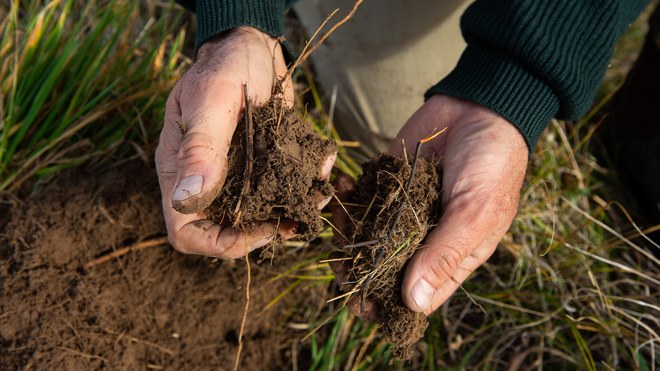
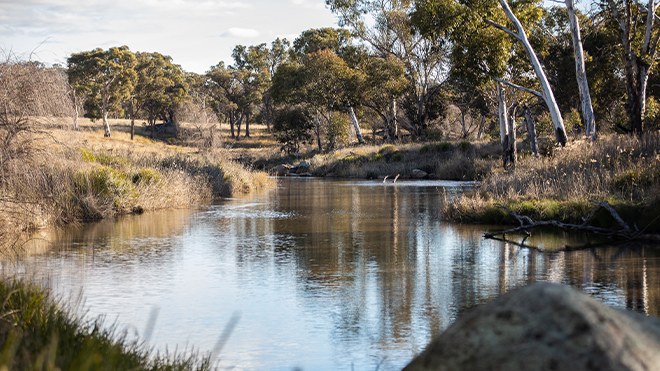
A new AWI-funded project is examining carbon movement across the whole farm system – livestock, pastures and soils – with the aim of developing a practical and credible way for woolgrowers to demonstrate carbon performance.
Building a whole-farm picture
The project is ultimately aiming to produce a measured and modelled, verification-ready whole-farm carbon footprint for the commercial wool enterprise.
Integrity Ag will bring life cycle assessment expertise to the project, incorporating livestock and production emissions alongside measured and modelled biogenic carbon flows and soil carbon removals.
The work will also examine a verification pathway aligned with relevant greenhouse gas accounting and Science Based Targets initiative guidance.
This is particularly important as companies throughout the wool supply chain face increasing requirements to measure and report their environmental performance.
The project will investigate how robust farm-level information could support credible supply-chain insetting – where businesses invest in reducing or removing emissions within their own supply chain rather than relying solely on carbon offsets generated elsewhere.
For growers, the objective is not to add another layer of complicated measurement to the farm business.
Instead, the research is examining whether high-quality measurement on a demonstration property can underpin modelling that is sufficiently robust to be replicated more affordably across similar production systems.
If the approach can be demonstrated to be accurate, repeatable and suitable for independent verification, it could also allow growers to explore the potential effect of management changes before making significant investments on farm.
What could it mean for woolgrowers?
The project is expected to deliver four key outcomes for the wool industry: a better understanding of biogenic carbon flows in commercial sheep production; a lower-cost and scalable verification pathway; a verified whole-farm carbon footprint incorporating livestock emissions and soil carbon removals; and practical information to help growers respond to emerging market and reporting requirements.
It also has the potential to provide stronger scientific evidence of how carbon moves through Australian wool-growing landscapes, while ensuring any claims about carbon performance are supported by robust measurement and verification.
Rather than considering emissions in isolation, the project will examine the interaction between livestock, pasture, soils, climate and management across the production system.
For woolgrowers, that could ultimately provide a more credible and practical way of demonstrating the environmental performance of the wool they produce.
The project commenced in May 2026 and is scheduled for completion in March 2028. Two on-farm field days, a webinar, a woolgrower case study and resources for advisers are planned as the research progresses.
This article appeared in Issue 106 of AWI’s Beyond the Bale magazine that was published in September 2026. Reproduction of the article is encouraged and should be attributed as follows: This article was first published in Issue 106 of AWI’s Beyond the Bale magazine.