




FlockMate puts sheep measurement in a new frame
Regular liveweight data can tell woolgrowers a lot about how their sheep are performing – from growth and condition to feed availability and readiness for key production stages.
The challenge is collecting that information regularly across an entire flock without adding another labour-intensive job to the farm calendar. A new research project led by CSIRO is looking to change that.
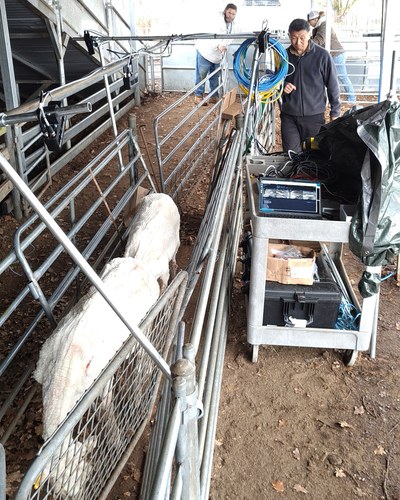
FlockMate, a two-year project co-funded by Australian Wool Innovation (AWI), Meat & Livestock Australia (MLA) and CSIRO, is devel-oping technology designed to estimate sheep liveweight and fleece weight in real time as animals move naturally past a sensor system. The aim is to provide more frequent, whole-of-flock measurements without the need for manual handling or relying on individual sheep voluntarily engaging with a weighing system.
How FlockMate works
- Sheep move past the sensors
The system is designed to capture measurements as sheep move naturally within view of the sensors, without the need for individual handling or voluntary engagement with a weighing system.
- 3D images are captured
A multimodal sensor system captures high-resolution 3D images of each individual animal.
- AI analyses the data
Advanced artificial intelligence and computer vision algorithms analyse the images to estimate body volume, liveweight and fleece weight.
- Results are linked to the sheep
Each measurement is automatically associated with the animal’s RFID tag, allowing changes to be tracked over time.
The aim
More frequent, non-invasive monitoring of sheep performance without interrupting normal farm operations.
Why liveweight matters
Liveweight – the combined weight of the sheep and its fleece – is an important production measure that can provide insights into feed availability, animal health and performance at key stages including lambing and preparation for sale.
Tracking changes in liveweight over time can also help identify shifts in growth or condition, giving producers another source of information to support management decisions.
But consistently capturing that data across large numbers of sheep remains difficult.
CSIRO Principal Research Scientist Dr Sabrina Greenwood said FlockMate was focused on finding a more practical way to collect the information under commercial farming conditions.
“Liveweight gives us important insights into how animals are performing but collecting that information consistently and across an entire flock can be difficult,” Dr Greenwood said.
“FlockMate is developing a way to capture that data more efficiently and in a way that fits within normal farm operations.”
Sheep, sensors and AI
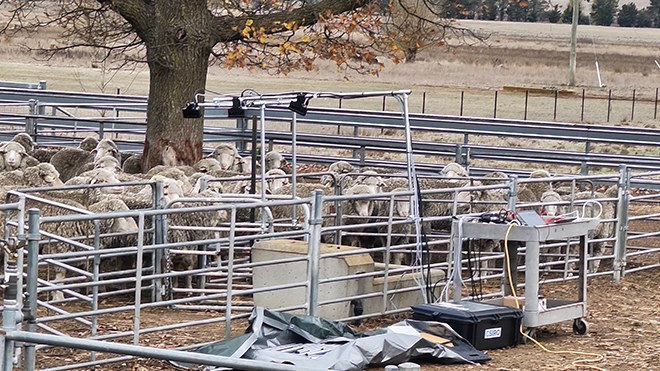
At the centre of FlockMate is a multimodal sensor system that captures high-resolution 3D images of individual sheep as they move within view of the sensors. CSIRO Quantitative Imaging Team Leader Dr Xun Li said advanced artificial intelligence and computer vision algorithms then analyse the data.
“Advanced AI and computer vision algorithms then analyse the data to generate accurate estimates of body volume, liveweight and fleece weight, with each measurement automatically associated with the animal’s Radio-Frequency Identification (RFID) tag,” Dr Li said.
“This enables frequent, non-invasive monitoring without interrupting normal farm operations.”
Importantly, the technology is being designed to collect measurements as sheep go about their normal movements, rather than requiring animals to be individually handled or trained to interact with a weighing system. If successful, that could allow producers to build a much more regular picture of changes in liveweight throughout the growth and production cycle.
Testing it on sheep
Early FlockMate prototypes are being developed and tested at CSIRO’s Chiswick Research Station in New South Wales.
The 1,500-hectare research property runs a Merino flock of about 2,700 breeding ewes, providing researchers with an opportunity to develop and test the technology under practical sheep production conditions.
The project is also drawing on insights from the Sustainable Chiswick Project, a separate but complementary initiative investigating on-farm sustainability and innovation.
However, researchers are not developing FlockMate in isolation.
More than 20 producers have already provided input into how they would use the technology and what it would need to deliver to work effectively in commercial sheep enterprises.
Dr Greenwood said that feedback was playing an important role in the development process.
“We’ve worked closely with producers to understand how they would use a system like this on farm, and that input has been crucial in shaping the design,” she said.
“Their feedback has ensured that the system is practical and reflects the real on-farm conditions that producers are working in.”
The project team will continue working with producers and supply chain stakeholders at key stages of development, with the aim of ensuring the technology is fit for purpose and has the potential to be adopted at scale.
More information, without more handling
For woolgrowers, the potential value of FlockMate lies not simply in replacing a trip across the scales, but in increasing the amount and frequency of information available about individual animals and the flock as a whole.
Regular measurements linked automatically to each sheep’s RFID tag could provide producers with a clearer picture of how animals are tracking over time, while reducing the labour and handling traditionally associated with collecting that information.
The addition of estimated fleece weight could further expand the production information available from the system.
FlockMate is still in the research and development phase, with work continuing to refine and validate the technology.
While the current project is focused on sheep, researchers believe its outcomes could ultimately have applications in cattle and other livestock industries, providing a foundation for future digital livestock monitoring technologies.
For now, the focus remains firmly on developing a system that can work where it matters – under practical Australian sheep production conditions.
This article appeared in Issue 106 of AWI’s Beyond the Bale magazine that was published in September 2026. Reproduction of the article is encouraged and should be attributed as follows: This article was first published in Issue 106 of AWI’s Beyond the Bale magazine.