




A new road for Australian wool
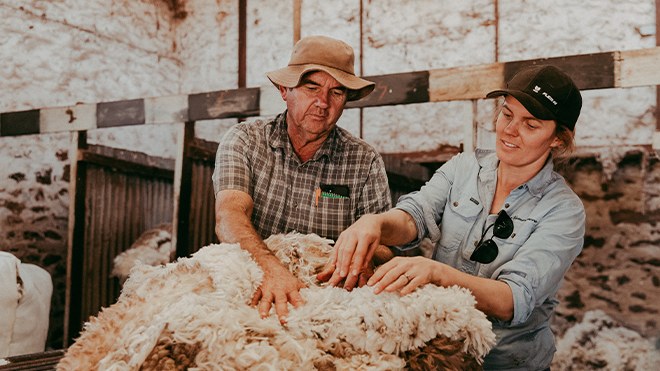
Homestead Road takes wool into a new generation of products.
Ask most consumers what a wool garment looks like and chances are they will picture a jumper, a coat or perhaps a finely tailored suit.
Bridgitte Brooks wants them to think again.
The fifth-generation Western Australian wool producer and founder of fashion label Homestead Road is using innovative OPTIM™ Merino wool fabric to create a contemporary puffer-style vest – taking Australian wool into a category more commonly dominated by synthetic fibres.
It is exactly the kind of reaction she wants when people first pick it up.
“People can’t believe it’s wool,” Bridgitte said. For Bridgitte, that surprise represents both the challenge and the opportunity facing the fibre she has grown up with – showing a new generation of consumers just how much Australian wool can do.
Built from the farm
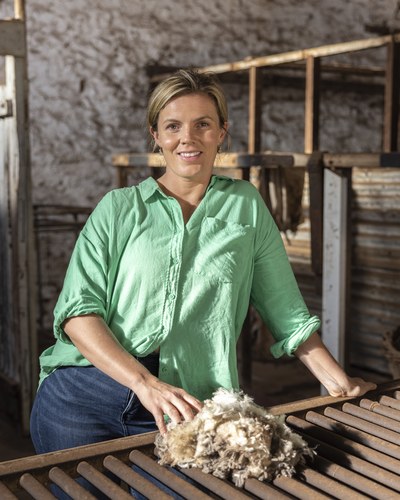
For fifth-generation wool producer Bridgitte Brooks, wool is more than the fibre her family grows – it is part of her history, her livelihood and now, her future.
Growing up on her family’s farm, Bridgitte spent plenty of time alongside her father in the sheep yards and always expected agriculture would become her career.
“I was always going to study ag, but there were droughts when I was in Years 11 and 12,” she said. “I ended up studying occupational therapy because I thought it was good to have something off-farm. I wanted to travel and I really like connecting with people and helping people.”
But agriculture was never far away and, 15 years later, after marrying farmer Jeremy Brooks, Bridgitte found herself firmly back in the world she had grown up in.
Today Bridgitte and Jeremy farm in the Yuna area of Western Australia’s Mid West, where they operate a mixed farming enterprise incorporating dryland cropping and cattle. Bridgitte also remains actively involved in her own family’s farming operation, which runs around 5,000 Merino ewes across 3,200 hectares.
And then there are Ted, eight, Tessa, seven, Grace, six, and Clementine, three.
Four children in five years changed Bridgitte’s life – and, unexpectedly, helped sow the seed for Homestead Road.
After becoming a mother, she became increasingly conscious of the role clothing could play in how women felt as their bodies, identities and daily lives changed.
At the same time, she could see a gap in the Merino activewear market.
At one end were highly technical performance garments. At the other were comparatively simple basics. What Bridgitte couldn’t find were modern, flattering and versatile wool garments designed for women whose days rarely fit neatly into one category.
Particularly women like her.
Homestead Road grew from the idea that clothes should be able to move from task to task and day to night – reflecting the reality of busy rural women who might move between the sheep yards, school pick-up, farm office and town all over the course of a single day.
But its beginnings were considerably less glamorous.
“I literally Googled how to start your own fashion business,” Bridgitte said.
She completed an online course, contacted Woolmark, reached out to established brands and started asking questions.
“I’m quite curious. I’m always happy to ask questions and to respect if people say no or they don’t want to share information, and I’m very grateful when people do.
“So that’s kind of how Homestead Road started.”
Several years of sampling, searching for reputable manufacturers and, Bridgitte readily admits, some expensive mistakes followed before Homestead Road officially launched in March 2025.
"I'm not a fashion type. I’m not known for my style," she said. "But I probably am known for my love of wool and the farm."
Wool for real life
That connection to wool sits at the heart of Homestead Road. The brand is built around versatility, quality, durability and sustainability, with Bridgitte determined to create timeless garments that also introduce more consumers to Australian Merino wool.
Her current collection includes leggings, jumpers, socks, caps and other pieces, designed around the realities of women’s lives rather than simply the traditional fashion model.
Bridgitte is equally pragmatic about what those garments need to deliver. If she wants a consumer accustomed to synthetic activewear to try wool leggings, for example, the wool version has to perform.
“They need to be a similar price to what people would pay for the plastic ones,” she said. “But it needs to do what the plastic ones do. It needs to hold up my mum tum and be comfortable.
“I’m 200 per cent confident once people try it, they’re absolutely converted. They just need to try it first.”
The same philosophy extends to fit. Bridgitte tests her garments across different body shapes and sizes rather than designing solely around the conventional size-eight fashion model – an approach particularly evident in the development of Homestead Road’s newest wool garment.
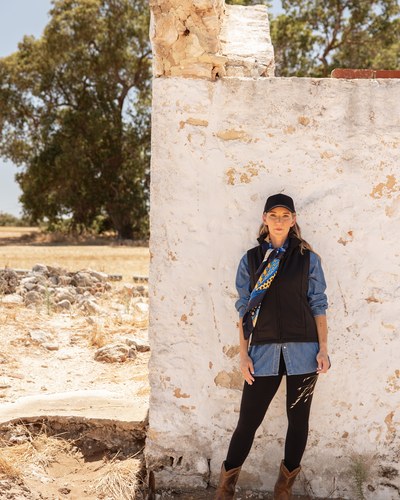
Homestead Road founder and WA wool producer Bridgitte Brooks is challenging perceptions of what wool can do with a puffer-style vest featuring an OPTIM™ wool exterior, wool filling and cotton lining.
Rethinking the puffer vest
It was through Woolmark information that Bridgitte first came across OPTIM™ fabric.
She immediately saw its potential. OPTIM™ technology allows Australian
Merino wool to be used in high-performance woven fabrics suited to applications well beyond the traditional wool knit.
For Bridgitte, it represented an opportunity to create something consumers might never expect to be made from wool – a puffer-style vest.
“I thought, this is fantastic,” she said.
“I need to get onto this so that I can show people just how flexible wool is and that it can be used for lots of different things.”
The Homestead Road vest uses OPTIM™ wool fabric on the exterior, wool filling and a cotton lining, creating a garment made entirely from natural fibres.
Bridgitte has also brought the Homestead Road philosophy to its design, creating a more feminine silhouette with an adjustable internal waist and vertical design lines intended to lengthen the body.
A vest also made sense because of its longevity and versatility. “You know, a vest is timeless if you get a nice style,” she said.
But perhaps her favourite attribute is what happens long after the garment has finished doing its job. “I don’t think there are many puffer vests that can return to earth once you’ve finished with them.”
For Bridgitte, it is another opportunity to challenge assumptions about wool.
Consumers frequently associate the fibre with conventional knitwear, she said, without realising the breadth of applications now possible.
“There are so many applications. I think if we can give consumers the opportunity to see these new and different technologies and fabrications, that’s going to open their eyes a lot more.”
Remaining OPTIM™ fabric is already earmarked for another Homestead Road project, with Bridgitte working with a manufacturer on a sports jacket she hopes will become available next year.
She is also pursuing Woolmark certification for the vest – something she believes would give both the business and its customers additional confidence in the quality and performance of the product.
Proudly Australian wool
While Bridgitte has ambitions to grow Homestead Road into a profitable, scalable business – and perhaps one day open a flagship store – her motivation extends well beyond selling clothes.
She wants Australians to reconnect with wool.
“I want Australians to be proud and celebrate wool,” she said.
For a fifth-generation wool producer, that connection is deeply personal. Wool, she says, has helped support generations of her family and countless others across the supply chain, from the people working on-farm to those who handle, process, manufacture and ultimately sell the fibre.
It is also part of the reason she and her children have the life they do today.
“Growing up, I fostered a love of wool. I was always helping Dad in the sheep yards,” she said.
Now she is watching another generation grow up with much the same freedom.
“Managing sheep is something you can do with the kids,” she said. “It’s such a joy and a gift to give your kids that opportunity to grow up on the farm.
“They’re in touch with nature and they know life and death. It builds resilience.
“I hope one day they look back and are grateful for that.”
That desire to protect the future of family farms sits alongside Bridgitte’s ambition for Homestead Road.
For her, creating demand for wool, connecting consumers with agriculture and building profitable and sustainable farm businesses are not separate conversations.
They are all part of ensuring there is something worth handing to the next generation.
And if Homestead Road can encourage a few more people to check the fibre content on a clothing label – or pick up a puffer vest and be astonished to discover it is wool – Bridgitte believes it is playing its part.
“We all do what we can in our own way.”
This article appeared in Issue 106 of AWI’s Beyond the Bale magazine that was published in September 2026. Reproduction of the article is encouraged and should be attributed as follows: This article was first published in Issue 106 of AWI’s Beyond the Bale magazine.