





Running the distance: Merino wool under real-world pressure
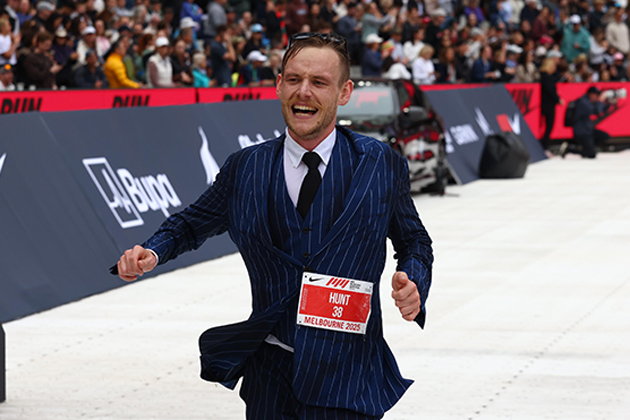
When Jason Hunt crossed the finish line of the Melbourne Marathon in a tailored three-piece suit, it landed as more than a visual surprise. It became a live performance test – one that placed Australian Merino wool under sustained, unscripted pressure in front of a global audience.
Hunt completed the full 42.2 kilometres in 2 hours, 38 minutes and 21 seconds wearing a custom suit by InStitchu, crafted entirely from Woolmark-certified Australian Merino wool – setting a world record for the fastest marathon ever run in a suit.
Designed specifically for endurance, the garment balanced structure, comfort and freedom of movement across nearly three hours of continuous exertion.
“This wasn’t just about turning heads,” Hunt said. “It was about raising awareness and funds for a cause close to my heart.”
Rather than a controlled demonstration or laboratory trial, the marathon presented an uncompromising test environment. Heat, physical fatigue and pace variation demanded consistent performance from the fabric – not just in moments, but across the full distance.
The project was led by Australian made-to- measure tailoring brand InStitchu, a long-standing Woolmark licensee known for combining modern tailoring with premium Australian Merino wool. Founded in 2011, the brand has grown to become Australia’s largest made-to-measure tailoring business, with showrooms across major cities.
InStitchu Co-Founder James Wakefield said the run reflected the brand’s philosophy.
“Jason’s run perfectly encapsulates what we stand for: custom garments that fit your body, your style and your story. We’re proud to support his mission.”
Jason Hunt – key stats
- 42.2km Marathon distance
- 2:38:21 Finish time
- $6750 Funds raised for charity: Movember
- Woolmark-certified Fabric: Woolmark-certified Australian Merino wool
Designed to perform, not just impress
The suit was milled by Italian textile house DRAGO, using lightweight Merino wool selected for breathability, elasticity and comfort. Construction choices were deliberate: an ultra-light canvas, unlined finish and a pinstripe fabric that reduced weight while maintaining form.
For the design team, garment weight proved critical. Every decision was made to ensure the suit could move naturally with the body, regulate temperature and remain comfortable under sustained strain – all without compromising appearance.
A different kind of proof point
In an apparel landscape increasingly focused on performance claims, demonstrations like this offer something harder to manufacture – credibility.
Rather than relying on technical specifications or controlled testing environments, the marathon provided an open, highly visible trial.
It showed how Merino wool behaves when pushed beyond everyday conditions – managing moisture, movement and heat in real time.
“For something that’s traditionally associated with tailoring, it handled the physical side better than I expected,” Hunt said.
“It challenged a few assumptions – including my own.”
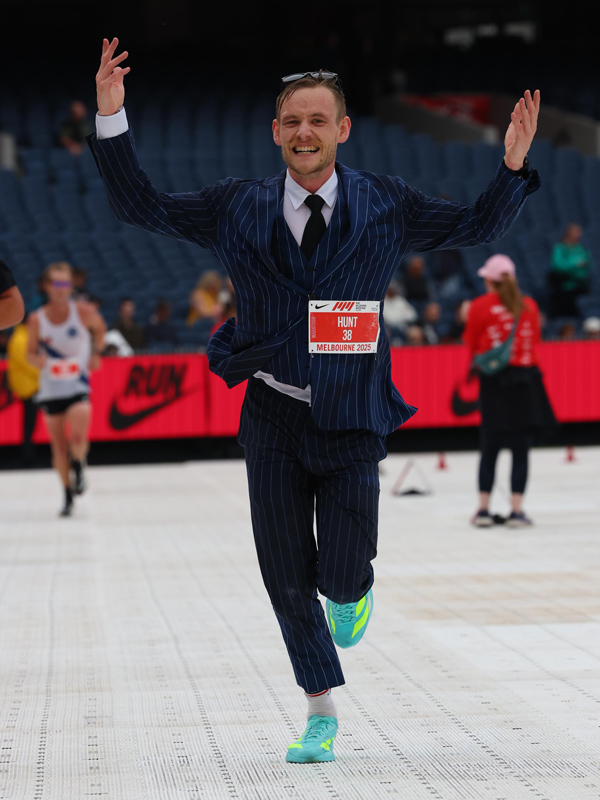
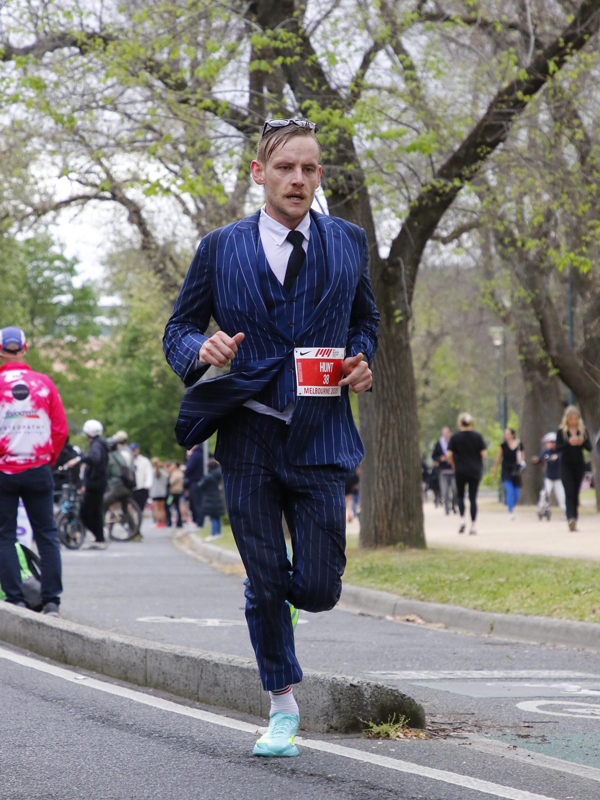
Left: Crossing the finish line in 2:38:21, the Merino suit demonstrated natural temperature regulation and unrestricted movement under real-world conditions. Right: Endurance in motion: lightweight Merino suiting engineered for breathability, elasticity and comfort across the full marathon distance.
Where material stories are heading
Across global apparel markets, expectations around materials continue to evolve. Consumers and brands alike are placing greater emphasis on versatility – garments that transition across settings without sacrificing comfort, durability or aesthetics.
Merino wool’s ability to operate in this space has long been recognised, but contemporary demonstrations help keep that story current.
They show how a natural fibre can meet modern performance briefs without leaning on novelty or nostalgia.
Beyond the finish line, the run also supported Movember, connecting the challenge to broader conversations around wellbeing and purpose.
“If this run got people thinking differently about what wool can do, that’s a win,” Hunt said.
“Especially if it also helps support a cause that matters.”
Quiet confidence
In a crowded fibre landscape, the most effective stories are often the least forced. One runner. One suit. One demanding test carried out in full view of the public.
Australian Merino wool didn’t need to announce itself. It simply did the work – and ran the distance.
When fibre cuts through
It’s easy to dismiss social media metrics as marketing noise. But every so often, the numbers tell us something more meaningful.
Recent Woolmark content exploring the biodegradability of a wool jumper has now been viewed more than 27.5 million times globally across social platforms, including amplification through AWI’s Instagram channel. Combined watch time on YouTube and TikTok alone equates to almost two years of continuous viewing.
That isn’t passive scrolling. That’s sustained attention.
For woolgrowers, this isn’t about chasing impressions. It’s about educating a new generation of consumers on our fibre.
In a digital environment dominated by synthetic performance claims, consumers are stopping to watch clear demonstrations of what wool can do — how it regulates temperature, manages moisture and, ultimately, returns safely to the soil at the end of its life.
The same science-led approach underpins Woolmark’s Dynamic Breathability content, which is also gaining significant traction online. Across Instagram alone, the campaign reached more than 3.7 million accounts, generating over 1.7 million views and 76,000 engagements. On YouTube, Dynamic Breathability content recorded more than 1 million views, while LinkedIn activity added further professional audience exposure.
Importantly, the strongest performing content is grounded in proof. Demonstrations of breathability. Visible evidence of biodegradation. Practical fibre science presented simply.
That principle also carried through to AWI’s Winter Olympics social media activity. Across Instagram and Facebook, Olympic-related content delivered measurable exposure during one of the world’s most watched sporting events.
Attention alone doesn’t guarantee demand. But relevance in consumer conversation is a necessary foundation for it.
What these results suggest is steady rather than sensational: wool’s inherent performance and environmental credentials are resonating beyond our own industry circles. The fibre’s fundamentals are translating clearly into modern consumer language.
In a crowded digital marketplace, wool is not simply participating. It is competing credibly.
And when consumers pause long enough to engage with the science behind the fibre, that is worth noting.
Biodegradability video
- 27,588,257 Global views across social channels
- YouTube and TikTok: Combined YouTube and TikTok watch time equivalent to almost two years of continuous viewing
Dynamic breathability content
- 3,720,917 Instagram reach
- 1,708,043 Instagram views
- 76,815 Instagram engagements
- 1,082,440 YouTube views
- 15,385 LinkedIn impressions
- 3,425 LinkedIn engagements
- 5,509 LinkedIn video views
Olympic exposure – Winter Games across Instagram and Facebook
- 3,720,917 Instagram reach
- 1,708,043 Instagram views
- 565 Instagram engagements
This article appeared in Issue 105 of AWI’s Beyond the Bale magazine that was published in March 2026. Reproduction of the article is encouraged and should be attributed as follows: This article was first published in Issue 105 of AWI’s Beyond the Bale magazine.