




The woolgrower’s guide to containment feeding
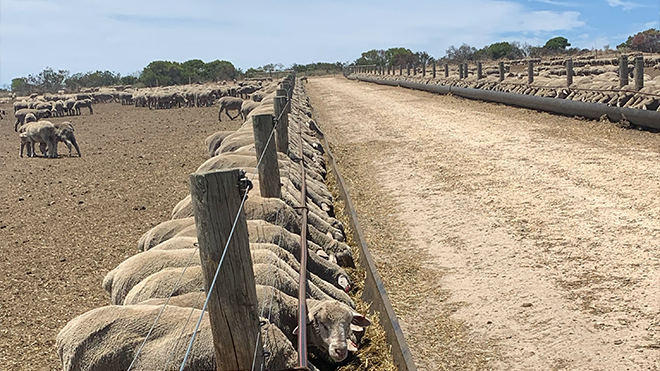
Containment feeding has become a vital tool for many woolgrowers to manage the summer-autumn feed gap. Read on for practical steps on site selection, nutrition and infrastructure, featuring insights from Esperance woolgrower Simon Fowler on how to lift flock performance while reducing costs through containment feeding.
Why containment feeding?
More than just a drought strategy, containment feeding helps woolgrowers:
- Protect soil and groundcover.
- Bridge the summer-autumn feed gap.
- Defer grazing at the break so pastures can establish properly.
- Maintain or lift body condition to improve reproductive performance.
- Finish lambs and manage weaners to reach growth targets for turnoff or to first joining.
- Strengthen drought preparedness and farm resilience.
Five key factors to consider when setting up a containment area
- Location and site selection
Choosing the right site is essential. The goal is a simple, functional site that balances practicality and sheep comfort and welfare, while protecting your soil and waterways.
Consider:
-
- Proximity to infrastructure – a site that is near yards, silos and water for easy daily management and monitoring.
- All-weather and easy access – accessible year round so feeding is possible in all conditions.
- Situated on well-drained soils with a slope of around 2–4% to avoid bogging. Avoid heavy clays that bog up and sandy soils that become dusty.
- A low risk of nutrient run-off and is at least 50 m from creeks and 100 m from streams, rivers and dams to avoid runoff issues.
- Provide shade and wind protection. If trees inside pens, protect them from ringbarking.
- Pen size and stocking density
Pen design directly affects welfare and management efficiency. Design your containment layout based on flock numbers and recommended stocking densities to ensure adequate space and trough access. Key factors include:
-
- Dry ewes – aim for 5 m2 per head (a mob of 500 requires around 2,500 m2)
- Pregnant ewes – 5–10 m2 per head
- Maximum mob size of 500 (200–300 for younger sheep) is preferable
- Use multiple pens to separate classes or ages and spell pens when needed
- It is not recommended to use containment areas for lambing.
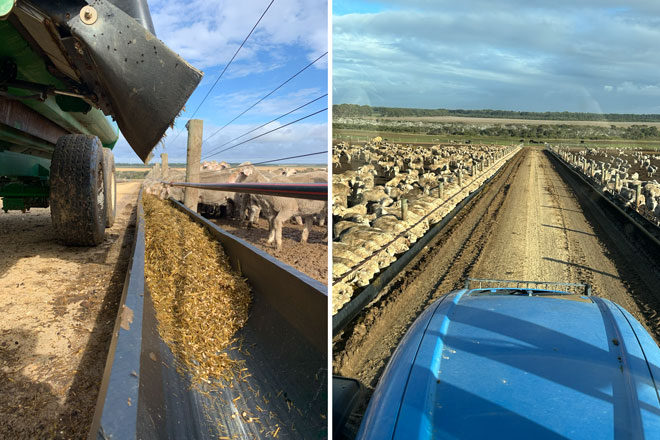
Left: Accurate, repeatable feed delivery supports rumen function, reduces feed wastage, and helps maintain target condition scores or growth rates — all fundamental to animal welfare and productivity.
Right: Purpose-built laneways improve efficiency and safety during feeding, allowing machinery access without disturbing sheep and keeping traffic off the containment surface to reduce soil damage and dust.
- Water supply and delivery
Water quality and supply are critical in containment – constant access to high-quality water is essential for optimal sheep health and performance. Tops tips include:
-
- Sheep need 4–6 L/day and up to 10 L/day in hot weather.
- Use water troughs rather than dams and clean them regularly.
- Shade troughs where possible and position them away from feed areas, ideally at the rear or lower end of the pen to reduce contamination.
- Provide at least 30 cm + 1.5 cm/head of trough space for mobs up to 500 head.
- Make sure you check that the system has a sufficient flow rate to handle peak water demand.
- Feeding system and feed budgeting
When designing your pens, decide how you’ll deliver feed. Think about:
-
- For daily or restricted feeding, provide 30–40 cm of single-sided trough space per sheep.
- Less trough space is required for self-feeders – 4–5 cm per lamb and 5–10 cm per adult.
- Include 10–15% roughage to maintain rumen function and avoid acidosis. Seek expert advice on your ration during the planning phase.
- Complete a feed budget before starting containment feeding with a 5–10% buffer. This buffer accounts for weather-related intake spikes and waste. Feed budgets ensure feed supply continuity and help track costs and refine feeding strategies season to season.
- Test the quality of your feed to ensure that you have an accurate understanding of how much you need for different stock classes.
- Regulatory and animal health
Before setting up and using your containment area, ensure both your paperwork and your livestock are protected. Sheep containment increases the risk of disease spread, so a ‘prevention is better than cure’ approach is essential.
-
- Compliance – check with your local government and state department to see if approval is needed before setting up your facility.
- Induction and health checks – vaccinate for diseases before entry and gradually introduce grain over 10–14 days to avoid grain poisoning.
- Ongoing monitoring – for signs of acidosis, salmonella, worms and pulpy kidney.
GROWER FOCUS
Simon Fowler
CHILWELL FARM
For Simon Fowler, who manages 30,000 Merino ewes at Chilwell Farms near Esperance in southern WA, containment feeding has transitioned from a drought strategy to a core management pillar. The shift was driven by the reality of modern cropping – efficient headers leave minimal grain in stubbles, creating an earlier feed gap. Furthermore, containment is essential for protecting fragile soils at Chilwell Farms following deep ripping and clay spreading, while allowing pastures like ryegrass and serradella to establish without grazing pressure.
Design and infrastructure
Simon emphasises that a successful containment system must be built for efficiency and animal welfare. Key design principles include:
- Strategic siting – pens should be located on well-drained ground near existing infrastructure—silos, silage pits and yards—to minimise travel and labour.
- Feeding efficiency – Simon utilises 100 m x 150 m pens that hold 700–800 ewes each with ~100 m of trough space. Simon employs an ‘outside-the-fence’ feeding model, which allows staff to deliver rations in a straight line without entering pens, significantly reducing labour requirements.
- Water quality – clean, daily-maintained water troughs are prioritised over dams to ensure high water intake and flock health.
Cost-effective production
A central philosophy at Chilwell Farms is to ‘use the synergies’ in their business. By utilising existing machinery and feeding a ration of pit silage and second-grade grain, Simon keeps input costs low. He maintains that a system doesn’t need to be high-tech; woolgrowers can start with simple yard extensions or holding paddocks and scale up from there.
Productivity and management
The benefits extend beyond soil health to significant production gains, including increased wool cuts, improved staple strength and higher pregnancy scanning rates. By containing ewes for eight weeks pre-lambing, they enter paddocks in peak condition, leading to superior milk production.
“We’re certainly cutting more wool per head. We’re also getting better staple strength. We’re certainly getting better conception rates in our ewes. Through that feeding for a good eight weeks before lambing, ewes are going into lambing in better condition... So you end up with a better lamb size, better body condition on the ewe, better milking ewe”
SIMON FOWLER, CHILWELL FARMS, WA
Key takeaways
Simon’s experience is straightforward: containment feeding doesn’t have to be expensive if you use what you already have and build slowly over time. Simon’s advice for starting with containment:
- Keep it simple – start with an existing holding paddock
- Use what you have – machinery, grain, homegrown silage, existing fences or panels
- Invest in good staff who care about your sheep and enjoy the work
- Get nutrition advice, especially for pregnant ewes. When managed correctly, containment feeding delivers a lift to the bottom line:
-
- Premium wool – higher fleece weights and superior staple strength.
- Reproductive success – higher scanning percentages and ewes in peak condition for lambing.
- Market flexibility – the control to finish your own lambs, grow weaners or put condition on your ewes, regardless of the season.
- Additional gains – improved groundcover and protected soils for better crop and pasture establishment.
To hear more tips from Georgia and Simon, check out:
THE YARN EPISODE 281
Containment feeding
AWI Extension WA Deep Dive, Episode 2
Containment feeding, made simple
For more information and to check out the resources used throughout this article, visit the following:
This article appeared in Issue 105 of AWI’s Beyond the Bale magazine that was published in March 2026. Reproduction of the article is encouraged and should be attributed as follows: This article was first published in Issue 105 of AWI’s Beyond the Bale magazine.