




Bioharvesting wool: where the research is heading next
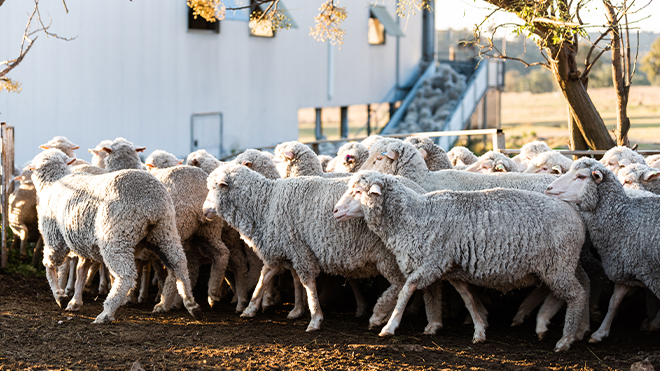
AWI-funded bioharvesting research has been underway for several years. As the project moves into its next phase, the focus is now on refining the most promising injectable agent pathways and moving closer to solutions that could work in real on-farm conditions
Bioharvesting at a glance
- Wool is weakened during growth, not cut at the skin
- A clean break point forms along the fibre
- Wool can be removed without blades
- Fibre continues to regrow normally after harvesting
After several years of foundational research led by Adelaide University, we have established that treated sheep do not lose wool in the paddock during the regrowth period; the harvested wool is more uniform than normal shearing; there are no second cuts or skin pieces; and there are no negative effects on sheep health. The bioharvesting program is now entering a more targeted phase. The science has confirmed that wool fibres can be weakened in a controlled way during growth. The work now underway is about what happens next – identifying the best candidate agents, testing them efficiently, and progressing the technology towards practical application.
For woolgrowers, this stage is less about theory and more about direction: what the research has delivered so far, what the next three years will focus on, and how this long-term investment could translate into meaningful on-farm outcomes.
Why this work matters to woolgrowers
From a woolgrower perspective, the value of this research lies in what it is designed to address over time – particularly labour availability, workplace safety and animal welfare expectations, while maintaining fleece quality and value.
If a commercially viable system can be developed, bioharvesting could offer:
- Improved animal welfare – no blades and no shearing cuts
- Better workplace safety – reduced physical strain and injury risk
- Cleaner fleeces – uniform fibre length and no second cuts
- Greater efficiency – faster harvesting and streamlined classing
- Future labour resilience – less reliance on highly specialised labour
What bioharvesting aims to do
In simple terms, bioharvesting works by creating a temporary weak point in the wool fibre while it is growing.
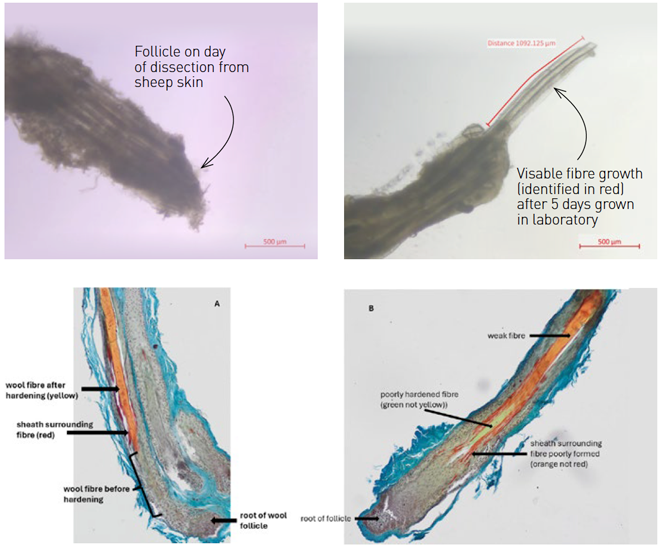
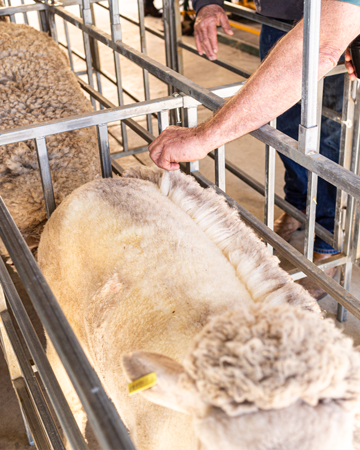
After treatment, the wool continues to grow normally. However, a defined “weak zone” forms along the fibre. When the fleece is ready to be removed, the wool can be broken cleanly at that weak point using mechanical force, rather than cut with blades.
Crucially for growers, wool growth continues underneath the break point, meaning fibre regrowth providing sheep with protection against sunburn and cold weather.
Where the research is up to now
Research conducted to date has confirmed that it is biologically possible to create a controlled weak zone within the wool fibre.
By targeting specific processes inside the wool follicle during fibre hardening, researchers have consistently weakened fibres so they can be broken using relatively low force. Microscopy studies have shown that the fibre structure is altered at a precise point, while normal wool growth continues below the weakened zone.
This work has moved the project beyond asking whether the concept works, to focusing on how it can be refined into a safe, reliable and repeatable system.
Why AWI is investing
AWI’s investment in bioharvesting research reflects a long-term approach to supporting woolgrowers. The aim is to explore technologies that could reduce risk, improve efficiency and strengthen the industry’s resilience, while maintaining the value and reputation of Australian wool.
What success looks like for growers
A successful bioharvesting system would:
- Maintain or improve fleece value
- Improve safety for people and sheep
- Fit within existing farm management systems
- Be commercially viable, not just scientifically possible
What a viable on-farm solution must deliver
For bioharvesting to be relevant on farm, any future product must meet strict practical criteria. It must:
- Work at a low dose
- Be safe for sheep and operators
- Have no negative impact on wool growth or quality
- Leave no residues in meat or body tissues
- Be simple to administer, likely by injection
- Be able to withstand on-farm conditions.
These requirements are central to the research program and guide every stage of development.
The next phase: moving closer to application
A new three-year research phase is now being contracted with Adelaide University to take the project forward. This stage focuses on identifying the most promising bioharvesting agents and refining them before progressing to further animal trials.
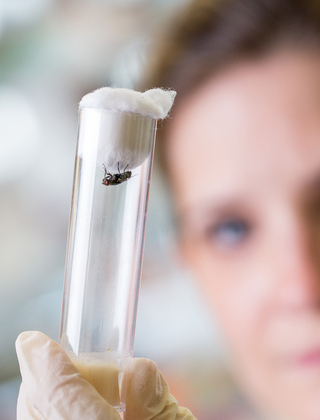
A key tool in this phase is a wool follicle culture system, where individual wool follicles are grown outside the sheep in controlled laboratory conditions. This allows researchers to rapidly test multiple potential agents and doses before moving to live-animal studies.
This approach reduces time and cost, while ensuring only the most promising candidates move forward.
At the same time, the project will begin engaging commercial partners with experience in bringing agricultural technologies to market and commence work towards APVMA approval, a necessary step for any on-farm product.
Looking further ahead
Once a suitable bioharvesting agent is confirmed, parallel work on mechanical fibre-breaking and automated classing systems will resume. Early engineering concepts have already been explored, but development was deliberately paused until the biological solution is clearly defined. This ensures any future harvesting system is designed specifically around the final bioharvesting method, rather than adapted later.
“The aim is a system designed from the ground up for woolgrowers and real farm conditions.”
CAROLINA DIAZ, PROGRAM MANAGER ANIMAL WELLBEING AND INDUSTRY RESILIENCE
What this means for the wool industry
Bioharvesting is not a short-term replacement for shearing, and it is not being developed in isolation from on-farm realities. Instead, it represents a long-term investment in wool harvesting options that could:
- improve animal welfare and safety outcomes
- reduce exposure to labour constraints
- protect fleece quality and value
- give woolgrowers greater flexibility inthe future
As with many AWI-funded projects, the goal is not disruption but building resilience and choice for Australian woolgrowers over the long term.
MORE INFORMATION
This article appeared in Issue 105 of AWI’s Beyond the Bale magazine that was published in March 2026. Reproduction of the article is encouraged and should be attributed as follows: This article was first published in Issue 105 of AWI’s Beyond the Bale magazine.